
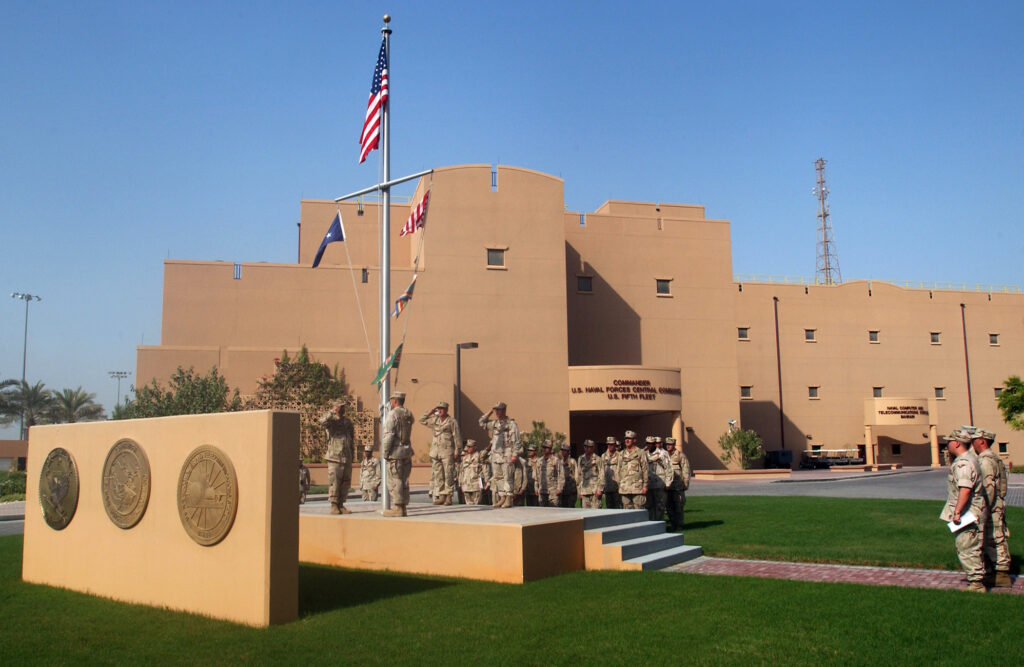
MANAMA, July 12 — The low hum of naval engines and the clatter of helicopter rotors have become the soundtrack of daily life at Naval Support Activity Bahrain, headquarters of the United States Fifth Fleet. On the ground here, residents describe a constant, steady presence of American warships and personnel, a force that has defined security in these waters for decades. The Fifth Fleet, established in 1995, is the U.S. Navy’s primary maritime arm across the Persian Gulf, Gulf of Oman, Arabian Sea, and Red Sea.
Its operational tempo is relentless. As of 2025, the fleet typically deploys an aircraft carrier strike group, amphibious ready groups, and patrol craft.
The USS Dwight D. Eisenhower carrier strike group, with about 7,000 sailors and 60 aircraft, forms the core of its striking power. Mine countermeasure vessels also operate under the fleet’s command.
And overhead, the U.S. Air Force’s B-52 bombers, stationed at Al Udeid Air Base in Qatar, provide a long-range strategic hammer.
A Coalition at Sea
The threat to commercial shipping in the region’s narrow chokepoints has been a persistent concern. In 2019, the U.S. launched the International Maritime Security Construct, or IMSC, a coalition of over 10 nations that includes the United Kingdom, Australia, and Saudi Arabia. The mission: protect merchant vessels transiting these volatile waters.
Exercises are a regular feature of the fleet’s calendar. Exercise Arabian Shark and Exercise Eagle Resolve, conducted with Gulf allies, test the fleet’s ability to respond to threats.
The U.S. Central Command, or CENTCOM, oversees all military operations in the region. As of 2025, General Michael Kurilla holds the command. The fleet’s presence is not new.
The U.S. Navy has operated in the Gulf for decades, but the Fifth Fleet’s establishment in 1995 formalized a permanent, forward-deployed posture. Today, it remains the cornerstone of American naval power projection in the Middle East.
The Eisenhower strike group, with its air wing and embarked staff, provides a mobile airbase and a visible deterrent. The amphibious ready groups bring Marine expeditionary units capable of landing forces ashore.
What to Watch Next
The coming months will test the fleet’s readiness. Tensions in the region show no sign of abating. The IMSC coalition will continue its patrols.
And the fleet’s integration with Air Force bombers at Al Udeid — a rare pairing of naval and air power — signals a joint approach to any future crisis. For now, the sailors of the Fifth Fleet remain on watch, their ships cutting through the Gulf’s warm waters, a constant in a region of flux.




