
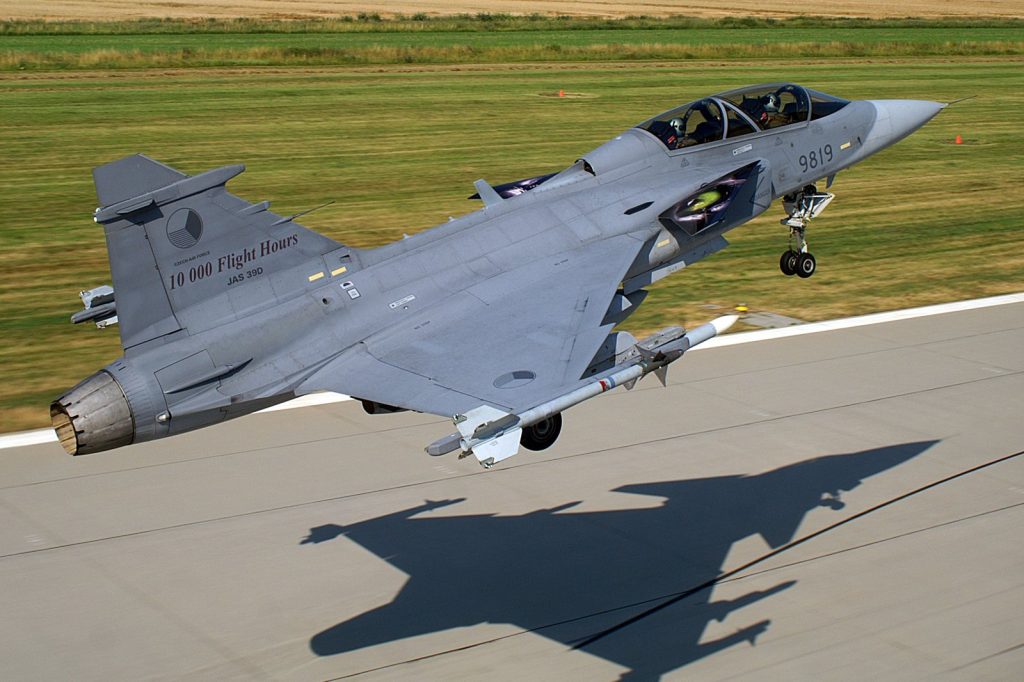
The Ukrainian Air Force has made a decision to acquire the Swedish-made Saab JAS 39 Gripen, a choice shaped directly by its experience operating American F-16 fighter jets under combat conditions. This procurement represents a strategic shift in how Ukraine plans to conduct aerial warfare.
Ukraine’s newly formed 107th Separate Aviation Wing currently operates F-16s, but not in a conventional manner. Instead of operating from fixed airbases with aircraft parked on runways, the wing employs a mobile approach. Jets take off from one location and land at another, while maintenance crews use truck-mounted mobile units for mission planning, repairs, and rearming.
This decentralized method prevents Russian forces from targeting stationary assets, a tactic that has kept Ukrainian aircraft operational. The Gripen was designed for precisely this type of dispersed operation.
Sweden developed the aircraft for its forested landscape, where long runways are scarce. The jet can land on highways, be refueled by a small ground crew, and take off again quickly. It does not require a large airbase with extensive support personnel—only a truck, fuel, and a stretch of road. The F-16, while a capable fighter, was built for a different operational environment.
The United States and NATO typically operate from fortified airfields with deep maintenance facilities and long supply chains. Ukraine cannot replicate this model because Russian missiles and drones would destroy static bases.
Ukrainian forces adapted by forcing the F-16 into a mobile, decentralized role, but the fit was not ideal. The Gripen, by contrast, was built from the start for autonomous, dispersed operations. A small team can rearm and refuel it.
Its support equipment fits on trucks, and it can operate from damaged runways or highway sections. The aircraft requires minimal specialized tools for rapid turnaround.
Ukraine’s decision to buy the Gripen indicates a long-term strategic outlook. Rather than simply accepting whatever Western aircraft are available, Ukrainian planners are evaluating what works on the battlefield and selecting weapons that match the realities of their war. The F-16 provided a modern fighter; the Gripen offers a modern fighter that aligns with Ukraine’s operational strategy.
Specific details of the procurement deal remain undisclosed, including the number of Gripens, delivery timeline, and cost. However, the strategic rationale is evident.
Ukraine is building an air force designed for survival, where every jet must be able to move, hide, and strike without relying on a fixed base. This marks a fundamental change from the Soviet-era model, which was centralized around major airfields and thus vulnerable. The new approach scatters aircraft and support, forcing adversaries to chase elusive targets.
The 107th Aviation Wing serves as a proof of concept, already operating this way with F-16s. The Gripen will serve as a better tool for the same mission.
Ukraine is not merely purchasing a new aircraft; it is adopting a new method of aerial combat.




