
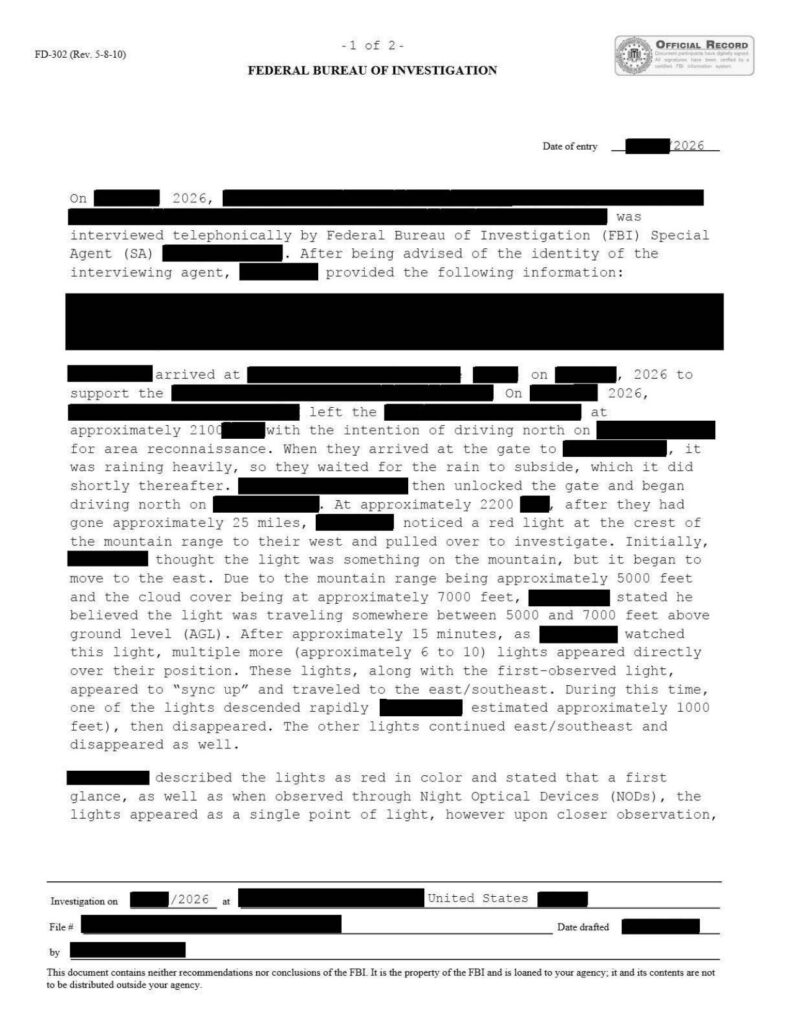
On August 7, 2026, an FBI interview documented two incidents involving unidentified red lights observed in the western United States. The account, recorded in FBI-UAP-D040, details a 2026 encounter near a mountain range where a driver and passenger reported seeing a single red light that moved eastward.
The observer, speaking to Special Agent After, noted the light’s trajectory between 5,000 and 7,000 feet above ground level. After 15 minutes, multiple additional red lights—estimated at six to 10—appeared in unison, syncing with the initial light before traveling east-southeast. One light descended rapidly by about 1,000 feet before vanishing, while the rest disappeared similarly.
The second incident, referenced in FBI-UAP-D037, involves a separate observer present during the same period. Both accounts are supported by FBI digital renderings, FBI-UAP-D041 and FBI-UAP-D042, which visually interpret the described phenomena.
The interviews were conducted telephonically, with the primary source providing details after being advised of the agent’s identity. The FBI has not issued conclusions or recommendations based on these reports, emphasizing that the documents are internal records. Geopolitically, the timing of these sightings—during heightened U.S. military activity in the region—raises questions about potential intersections between civilian observations and national security operations.
The FBI’s release of these files as part of the PURSUE tranche suggests a deliberate effort to catalog UAP-related data, though the agency maintains no official stance on the incidents’ nature. Analysts note that such reports, while anecdotal, contribute to a broader pattern of UAP disclosures that have intensified since 2020, particularly under the current administration’s approach to transparency.
What these accounts signal is a persistent challenge in reconciling public observations with official narratives. The description of synchronized lights moving in coordinated patterns defies conventional explanations, whether natural or technological. The FBI’s reliance on digital renderings to supplement witness testimony underscores the difficulty of verifying such events without physical evidence. This gap between perception and proof remains a critical issue in UAP studies, one that could influence future policy or military focus.
As the FBI continues to process these records, the public and intelligence communities alike will watch for further disclosures. The agency’s handling of UAP cases—marked by a mix of caution and incremental transparency—reflects a strategic calculus: balancing openness with operational security.
For now, the red lights of August 2026 remain a focal point in the ongoing geopolitical chessboard of UAP investigations, with implications that extend beyond the skies to the broader discourse on national defense and scientific inquiry.




