
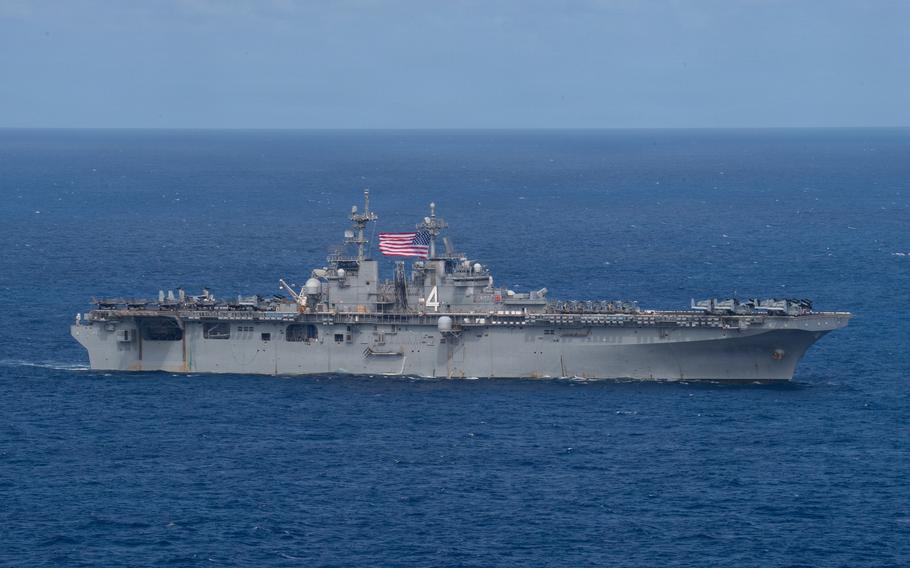
MANAMA — The hum of P-8 Poseidon surveillance aircraft now cuts through the heavy Gulf air above the Strait of Hormuz, a constant electronic watch over waters where the U.S. Fifth Fleet is bracing for the next move. On the ground here in Bahrain, the fleet’s headquarters, the mood is taut. Established in 1995, the Fifth Fleet is the Pentagon’s naval muscle for the Persian Gulf, the Gulf of Oman, and the Arabian Sea.
Its carrier strike groups and destroyers have long been a fixture in these waters. But since the April 1, 2025 attacks, the Pentagon has ordered up additional Arleigh Burke-class destroyers and those P-8 Poseidon planes.
The mission, commanders stress, is not new: ensuring freedom of navigation through the Strait of Hormuz, a right enshrined under the 1982 UN Convention on the Law of the Sea. What has changed is the threat. Iran’s small-boat swarm tactics are the worry now.
Fast attack craft, packed with anti-ship missiles, can dart out from the coastline, a diffuse and asymmetric danger. The U.S. Navy’s rules of engagement are clear: self-defense is authorized, including the authority to sink hostile vessels.
No American ships have been damaged in this current escalation, but the potential for a sudden, violent contact is ever-present. By nightfall, the fleet is not operating alone. The U.S. coordinates closely with the International Maritime Security Construct, or IMSC, a coalition formed in 2019.
Its members — the United Kingdom, Australia, and host nation Bahrain — share a common ‘sensor-to-shooter’ network. This system is designed to detect a threat the moment it emerges and pass the targeting data instantly to whichever warship is best positioned to respond. The Fifth Fleet runs on this rhythm: the drone of surveillance planes, the low-slung silhouette of a destroyer on the horizon, the constant relay of data from the sensor network.
Residents of the Gulf states describe a familiar tension, a waiting game played out over the world’s most critical oil chokepoint. The Strait of Hormuz remains the strategic prize.
For now, the fleet holds its position, its warships a visible line in the water. The next few days will tell whether this show of force is enough to deter the swarm.




