
NASA Releases Gemini and Apollo Astronaut Debriefings in UAP Files Recently, the Department of War disclosed a third batch of Unidentified Aerial Phenomena (UAP) documents. Tucked within is a treasure trove of astronaut debriefings from NASA’s Gemini and Apollo space programs in the 1960s. These early human spaceflight records offer unique insights into the observations and technical details of missions half a century ago.
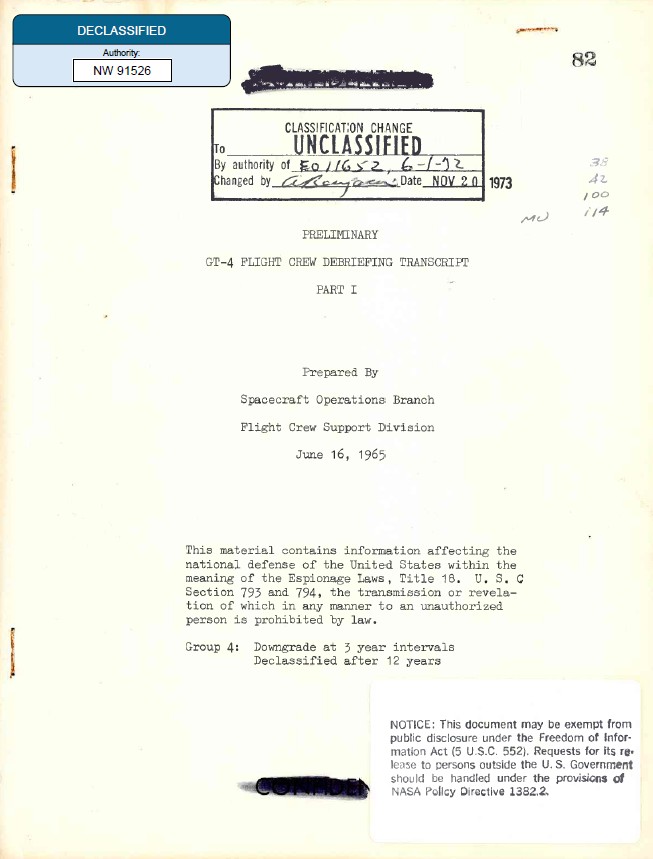
One standout document, a transcript from the Gemini 4 flight crew debriefing on June 9, 1965, notes astronaut Ed White reporting visual sightings of “sparkles” during the mission. This mission, commanded by James McDivitt and crewed by Edward White, stands as a significant milestone in space exploration history.
Why so? Because from June 3 to June 7, 1965, Gemini IV marked the second crewed mission in NASA’s Gemini series and, most notably, saw the completion of the first American spacewalk by Edward White. This mission set the stage for future space endeavors and proved that astronauts could work outside their spacecraft in space.
The collection is vast, encompassing transcriptions from multiple Gemini missions detailing bright particles observed by astronauts outside their spacecraft. These transcripts, some of which date back to June 25, 1967, and are spread across pages 78-81, 101 of the declassified documents, provide a unique window into the astronauts’ experiences and perceptions during these pioneering spaceflights.
Among the missions included is Gemini 5, whose crew technical debriefing took place between August 30 and September 2, 1965, at Cape Kennedy, Florida. This continuous dialogue offers raw, unfiltered accounts of astronaut discussions about celestial and terrestrial observations and anomalies. They noted sightings of Mercury, meteors, aurora, and lightning and how the appearance of the sun made other stars invisible.
The Gemini 7 mission’s flight crew debriefing conducted between December 19-21, 1965, at the same location is also part of the released documents. Reports mentioned lights and flashes, and there was a concern about having the right kind of light for the spacecraft to dock. A cornerstone in the Gemini series was Gemini IX (later renamed Gemini IX-A), launched on June 3, 1966.
Its objectives included a spacewalk and a plethora of scientific and medical experiments. A debriefing on June 16, 1966, featuring astronauts Thomas Stafford and Eugen, is documented, offering analysts a look at the astronauts’ accounts of their mission.
Now that these records have been made public, researchers, scientists, and space enthusiasts alike are eager to comb through the pages to unearth clues on the nature of what the astronauts observed. The release of these documents not only expands the historical archive but also increases public knowledge of early space exploration. As analysts delve into the details, the hope is that these accounts may provide more context or explanations for some of the unexplained phenomena observed during these missions.
Whether they illuminate new details about space anomalies or provide an interesting look into astronaut experiences, these documents are undoubtedly a valuable contribution to space history.
Background and why it matters
NASA, the National Aeronautics and Space Administration, is the U.S. government’s civilian agency for spaceflight and space science. It was established in 1958, during the Cold War’s Space Race, and grew out of the earlier National Advisory Committee for Aeronautics. That change gave the nation’s space program an explicitly peaceful, civilian direction rather than a military one. From that starting point, NASA came to lead nearly every major American spaceflight effort, including Project Mercury, Project Gemini, the Apollo program, Skylab, the Space Shuttle, the International Space Station, and the current Artemis program.
The agency’s early years were defined by speed and necessity. Project Mercury proved that astronauts could survive and work in orbit. Project Gemini followed, and it was there that crews learned how to maneuver spacecraft, rendezvous and dock, and step outside their vehicles during spacewalks. Those techniques made the Apollo Moon landings possible, culminating in the first lunar landing in 1969. The astronaut debriefings from this era, recorded in the 1960s, are part of that foundational period. They capture the raw give-and-take of crews describing what they saw and experienced when spaceflight was still experimental and little was known.
Over the decades, NASA broadened far beyond human spaceflight. Its robotic missions have mapped the planets, studied the Sun, and turned powerful space telescopes toward distant galaxies. The agency also built lasting partnerships with other countries, most visibly through the International Space Station, and later turned to private companies to carry crews and cargo to orbit. This mix of government research and commercial cooperation reshaped how space projects are planned and paid for, and it remains the model for much of today’s space activity.
NASA still matters now because it sets the pace for the next chapter in space exploration. The Artemis program aims to return astronauts to the Moon and to build a sustainable presence there, with an eye toward later human missions to Mars. At the same time, the agency’s historical records continue to draw fresh attention as new generations review early mission files with modern questions in mind. For readers, NASA is more than a space agency; it is the institution that defines how the public understands what is possible beyond Earth, and its archives remain a living record of humanity learning to leave the planet.




