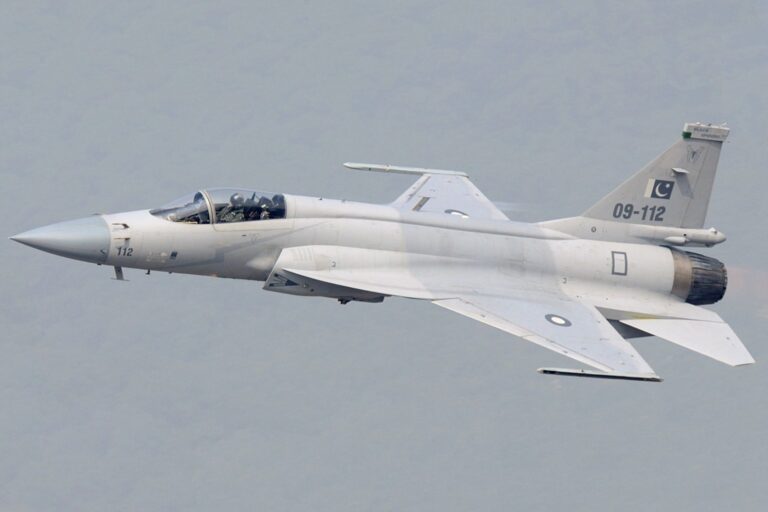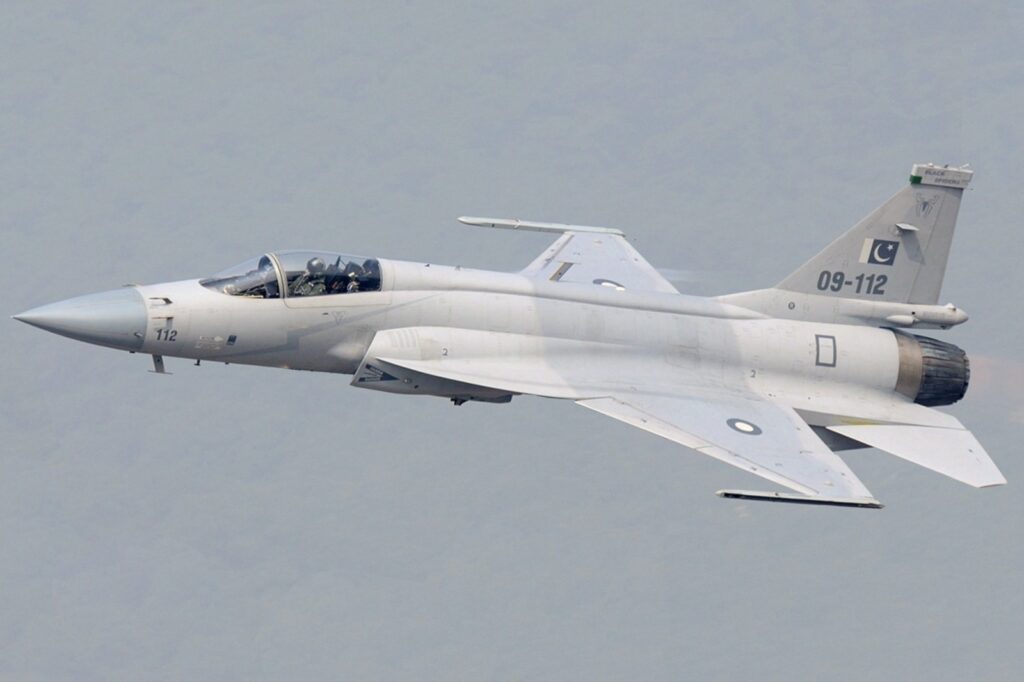
Pakistan conducted the first flight test of its domestically developed Fa’az air-to-air missile on 3 November 2026, launching the imaging infrared-guided Fa’az-IIR variant from a JF-17 Thunder Block I fighter, serial number 09-109, according to the Pakistan Air Force’s Directorate General of Public Relations.
The Missile Family and Published Performance
The Fa’az program, developed by the Air Weapons Complex under the National Engineering and Scientific Commission (NESCOM) and marketed by Global Industrial & Defence Solutions (GIDS), comprises two primary guidance variants for the initial Fa’az-1 standard. The Fa’az-IIR tested on 3 November uses an imaging infrared seeker with a reported target acquisition range of 40 to 45 kilometres. The Fa’az-RF variant employs an active radar-homing seeker with an acquisition range of 25 kilometres. Published specifications list the total operational range at over 75 kilometres and Mach 3.2 for the IIR version, and exceeding 100 kilometres at Mach 3.5 for the RF version. A longer-range Fa’az-2, projected at approximately 180 kilometres, is envisaged but has no disclosed test schedule.
Platform Integration and Combat Radius
The JF-17 Thunder is a single-engine lightweight supersonic multirole combat aircraft jointly developed by the Pakistan Aeronautical Complex (PAC) and China’s Chengdu Aircraft Corporation. The airframe serves as the backbone of the Pakistan Air Force, complementing the F-16 Fighting Falcon at approximately half the cost, with the Block II variant priced at $25 million. The test utilized a Block I airframe, one of the earliest JF-17s to undergo a major overhaul at PAC beginning in 2019. The newer Block III variant incorporates an active electronically scanned array (AESA) radar and an additional hardpoint, expanding weapons carriage options.
Integration of the Fa’az family alters the JF-17’s combat profile by providing an indigenous beyond-visual-range (BVR) option. The Fa’az-RF’s published range exceeding 100 kilometres extends the jet’s no-escape zone against aerial targets without relying on imported Chinese PL-15E or SD-10 missiles. The Fa’az-IIR’s imaging infrared seeker, with its 40 to 45 kilometre acquisition range, adds a passive engagement capability useful against low-signature or electronically noisy targets. Both variants employ lock-on-after-launch logic, receiving mid-course guidance via datalink from the launch aircraft before autonomous terminal homing. This allows the JF-17 to engage targets at distances that stretch the practical combat radius for air superiority missions, particularly when paired with the Block III’s AESA radar for initial track data.
Export Competitiveness Against the F-16V
The Fa’az program explicitly seeks to reduce Pakistan’s dependence on imported weaponry from suppliers like China and the United States, according to GIDS and NESCOM statements. For export customers, a JF-17 Block III armed with an indigenous BVR missile sidesteps the end-user restrictions and political conditions that govern US Foreign Military Sales of the F-16V and its AIM-120 AMRAAM complement. The JF-17’s established cost advantage — roughly half the acquisition price of an F-16V — combines with a sovereign weapons suite to offer a package free of third-party re-export licenses. GIDS displayed Fa’az mock-ups at the IDEF exhibition in Türkiye in July 2023, signaling active marketing to existing JF-17 operators and potential buyers. The authorities have not disclosed when the Fa’az will reach initial operational capability or which units will introduce it first.
Sources
- Pakistan Tests Its Own Fa'az Air-to-Air Missiles for JF-17 Fighter Jet | Defense Express
- CAC/PAC JF-17 Thunder
- Pakistan successfully flight-tests indigenously developed Fa’az missile from JF-17 fighter
- Fa’az Missile: Pakistan’s First Air-to-Air Missile | MiGFlug
- Pakistan Test-Fires Fa’az Air-to-Air Missile From JF-17
- Pakistan tests the Fa’az, its first domestically developed BVR air-to-air missile
Photo: Shimin Gu (CC BY-SA 4.0)