The U.S. Army has awarded AeroVironment a production contract for a high-energy laser weapon, the first time the service has bought directed-energy weapons at scale rather than as prototypes. The September 2026 award, valued by AeroVironment at $464.8 million, covers the Enduring-High Energy Laser program and its LOCUST X3 system, and on Monday Leonardo DRS confirmed it had been selected by AeroVironment to supply the rugged integration work that makes the weapon practical in the field.
That subcontract is the detail that matters. The Army has had laser weapons that worked on test ranges for decades. What it has not had is one that survives mud, heat, dust and a vehicle electrical system that was never designed to feed a 30-kilowatt beam.
How the LOCUST X3 Works
The LOCUST X3 is a 30-kilowatt laser designed to shoot down small drones. A laser that size needs a large, steady supply of electricity to fire, and most of that energy becomes heat that has to be carried away so the weapon can keep firing. Under the subcontract, Leonardo DRS will provide the power-management and environmental-control systems and the rugged work to mount the laser on vehicles.
AeroVironment designed the X3 to be platform-agnostic, intended for integration across a range of military platforms including the Army’s Joint Light Tactical Vehicle, with palletized configuration options that set up on the ground. The company says each shot costs less than $10, against tens of thousands of dollars for an interceptor missile. That ratio is the commercial argument for directed energy: a drone that costs a few hundred dollars should not be answered with a missile that costs five figures.
The Army said E-HEL is intended to give soldiers a scalable, affordable directed-energy system that strengthens counter-unmanned aircraft operations. AeroVironment vice president of directed energy John Garrity said the deal covers more than 26 lasers, with the first unit on track for 2027 and counter-drone operations expected by early 2028. The company has said it expects to deliver well into the dozens of LOCUST X3 systems in the coming years.
The Power and Heat Problem
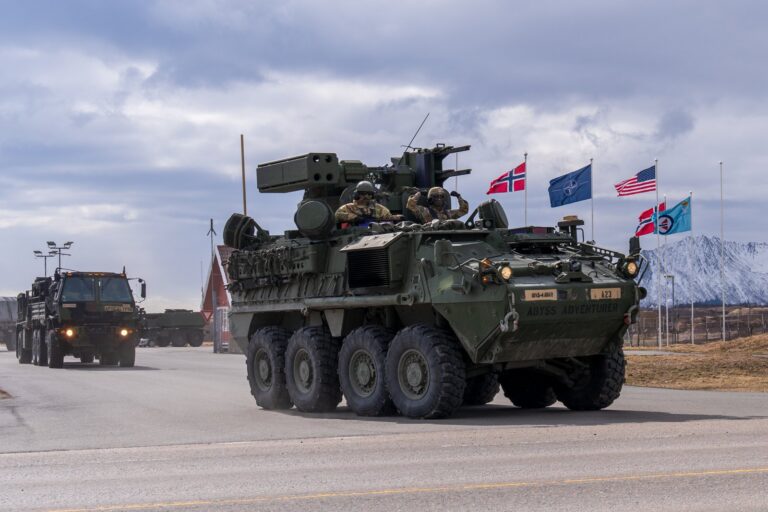
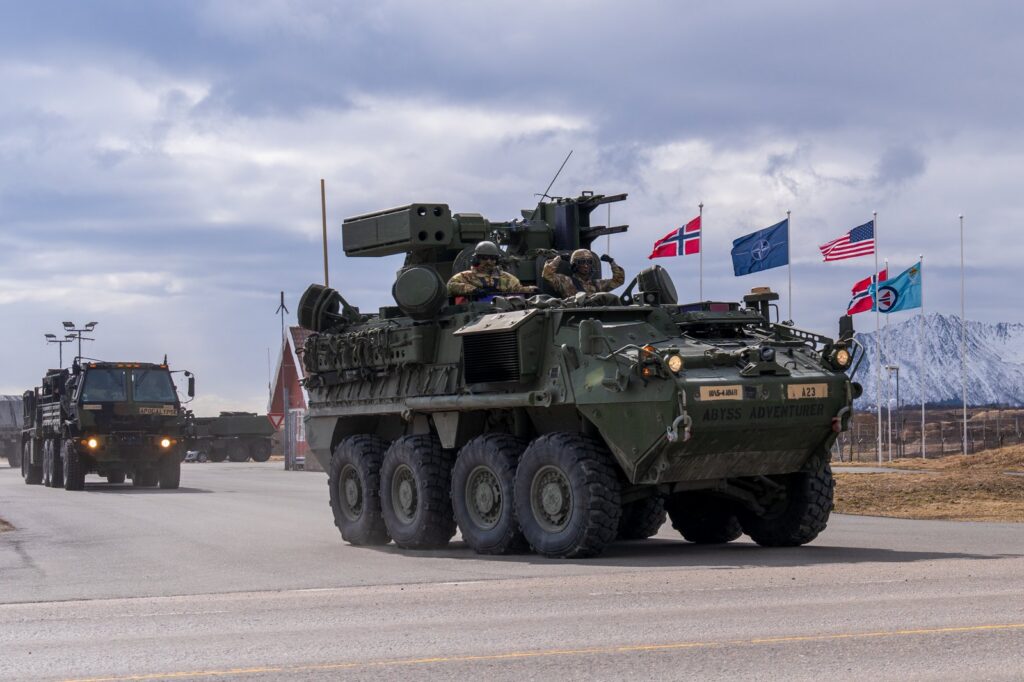
The technical reality of a mobile laser is that the beam is the easy part. In early 2024 the Army sent four Stryker vehicles carrying 50-kilowatt lasers, the Directed Energy Maneuver Short-Range Air Defense system, into the field. The effort stalled on electrical-power and heat problems, and the new subcontract is aimed squarely at that failure. DRS’s task is to make the weapon work reliably in the field, not just on a test range.
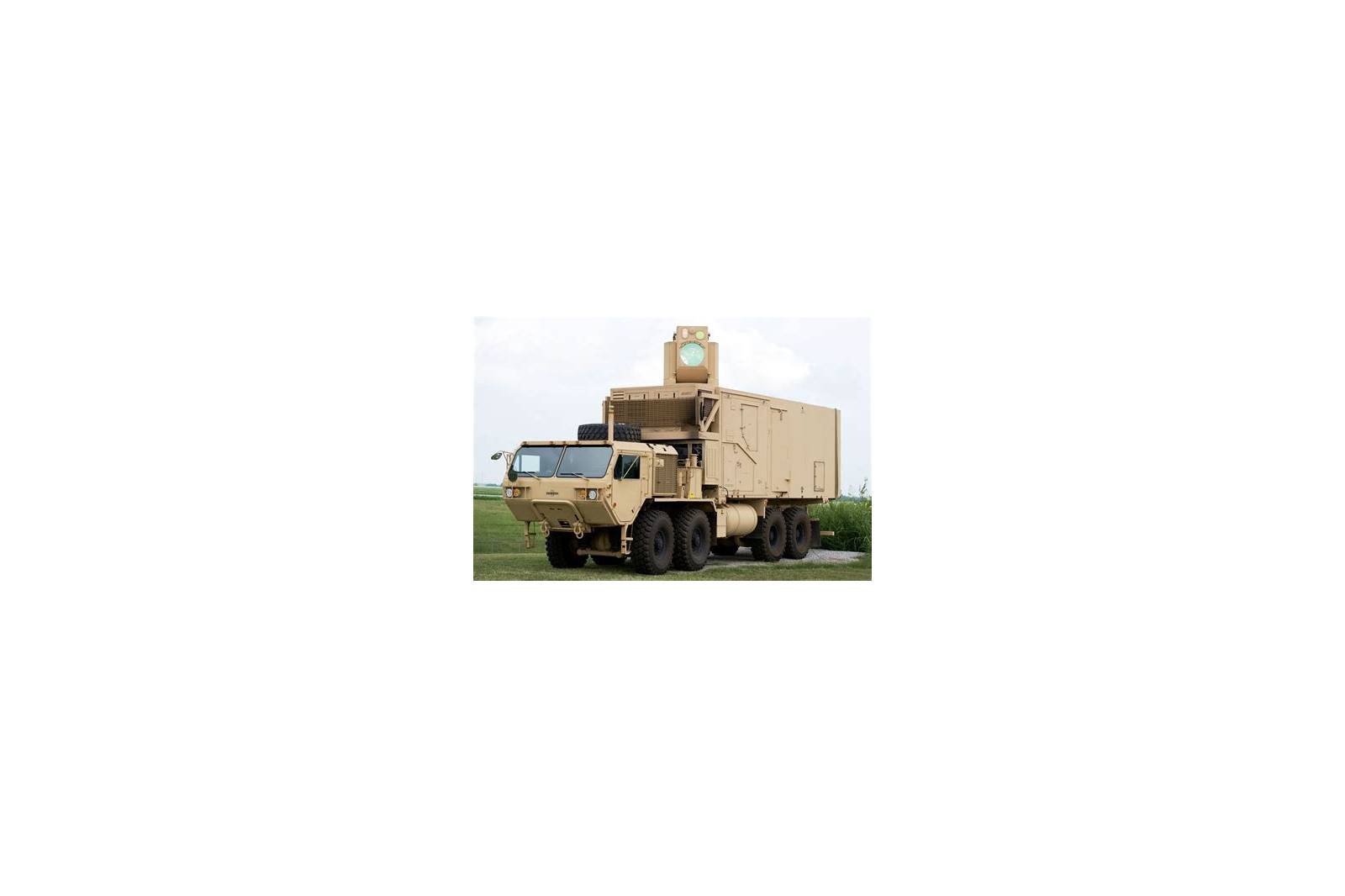
DRS brings prior work to the job. The company provided vehicle-integration, power, thermal-management and systems-engineering expertise for a rapid-prototyping effort with AeroVironment and other industry partners to integrate a counter-drone directed-energy system into an armored vehicle, supporting U.S. government live-fire evaluations and training in 2024 and 2025.
“Evolving drone threats demand systems that deliver reliable performance in demanding operational environments,” Aaron Hankins, vice president and general manager of Leonardo DRS Land Systems, said in a statement. “Our team is applying experience in vehicle integration, power and thermal management to help AV deliver a mobile high-energy laser capability for the U.S. Army.”
John Baylouny, president and chief executive officer of Leonardo DRS, framed the award as a shift in emphasis. “The Army’s move to production reflects the growing importance of scalable, fieldable directed-energy capabilities in countering evolving UAS threats,” he said. Neither company disclosed the subcontract’s value, how many systems it covers, or when deliveries begin.
From Six City Buses to a Tactical Vehicle
The historical comparison is stark. The Tactical High-Energy Laser, or THEL, was a joint U.S.-Israeli program agreed in July 1996 that used deuterium fluoride chemical laser technology. The prototype was roughly the size of six city buses, built from modules holding a command center, radar and tracking telescope, the chemical laser itself, fuel and reagent tanks, and a rotating mirror to steer the beam toward speeding targets.
It worked, in its way. In 2000 and 2001 THEL shot down 28 Katyusha artillery rockets and five artillery shells, and on November 4, 2002, it downed an incoming artillery shell. A mobile version, MTHEL, completed successful testing, and in August 2004 the system shot down multiple mortar rounds in a test representing actual mortar threat scenarios, intercepting both single rounds and salvos.
But the mobile redesign was the program’s undoing. The fixed design eliminated most weight, size and power restrictions and was incompatible with the fluid nature of modern combat. The initial mobile goal was a version the size of three large semi trailers, ideally downsized to one, while keeping the original performance. The Israeli government, which had been providing significant funding, decreased its financial support in 2004, pushing the initial operating capability date to at least 2010, and the program was discontinued in 2005.
Under the hood, the difference between THEL and LOCUST is chemistry. THEL’s deuterium fluoride laser was a chemical system: it consumed fuel and reagent, and its exhaust and logistics train were part of the weapon. A 30-kilowatt solid-state laser draws its power from the vehicle and puts its waste heat into a cooling loop. That is why power and thermal management, not the optics, decide whether the system fields.
A Layered Defense, Not a Silver Bullet
The Army is not betting on lasers alone. Last month the Pentagon announced that AeroVironment’s Palletized High-Energy Laser system was one of the platforms chosen for a pilot led by Joint Interagency Task Force 401. The other directed-energy technologies selected include the Epirus Leonidas High-Powered Microwave system, the Kord Firefly High-Energy Laser system and the Boeing Compact Laser Weapon system.
“High-energy lasers and high-powered microwave systems are tools that can be effectively used in a layered drone defense,” Army Brig. Gen. Matt Ross, director of JIATF 401, said in a statement. The pairing is deliberate: a laser burns a single target with a precise beam, while a high-powered microwave can disrupt or destroy the electronics of several drones at once.
For an ordinary reader, the significance is less about science fiction and more about economics and magazine depth. A ground unit facing a swarm of cheap reconnaissance or one-way attack drones currently has to choose between machine guns, electronic jamming and missiles that cost tens of thousands of dollars each. A laser with a sub-$10 shot cost changes that arithmetic, provided it has the electrical power and cooling to keep firing.
What Comes Next
The production contract is the milestone the directed-energy community has been promising since THEL first fired. The Army now has a prime contractor, a laser design in the LOCUST X3, and a subcontractor whose explicit job is to solve the power and heat failures that stopped the Stryker effort. Whether dozens of 30-kilowatt lasers can be sustained in the field, rather than demonstrated on a range, is the question the next two years will answer.
Sources
- Tactical High Energy Laser
- Leonardo DRS tapped to support Army’s high-energy laser program
- Leonardo DRS Fixes Power and Heat Flaws for Army's First Production Drone Laser | SOFX
- UPDATE — Leonardo DRS Selected by AV for U.S. Army’s Enduring-High Energy Laser Production Program
- Leonardo DRS Selected by AV for U.S. Army’s Enduring-High Energy Laser Production Program
- Leonardo DRS to support AeroVironment’s LOCUST X3 production for U.S. Army’s first high-energy laser weapon production program – Defence Industry Europe
Photo: U.S. Army photo by Capt. Alexander Watkins (Public domain)