
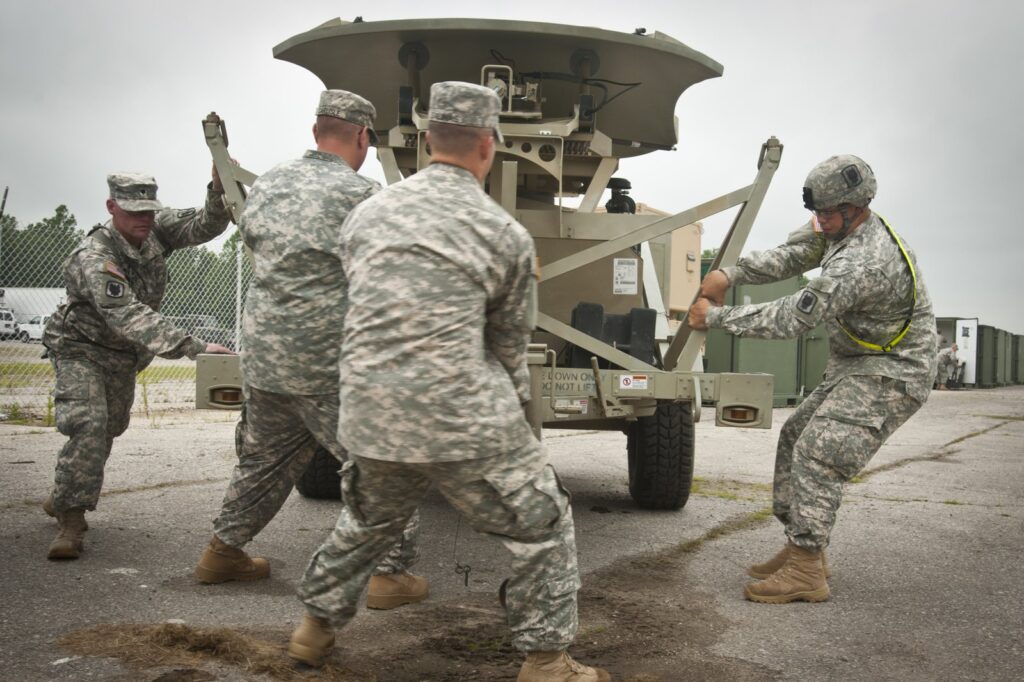
Raytheon Wins $8 Billion IDIQ Contract to Modernize U.S. Nuclear Command and Control Terminals
The U.S. Air Force has awarded Raytheon an indefinite-delivery/indefinite-quantity contract with an $8 billion maximum ceiling for developmental modernization, production restart services, and technical studies associated with the Air Force Nuclear Weapons Center’s Strategic Communications Terminals.
At the time of award, the Air Force is obligating $800,000 in fiscal 2026 research, development, test, and evaluation funds.
Contract Award Details and Scope
The contract, numbered FA2293-27-D-B001, was awarded on a sole-source basis by the U.S. Air Force Nuclear Weapons Center at Hanscom Air Force Base in Massachusetts. It covers work at Raytheon facilities in Marlborough, Massachusetts, and Largo, Florida. The effort includes development, production restart, and technical studies for strategic communication terminals used in nuclear command, control, and communications (NC3). Work is expected to be completed by October 12, 2036. The $8 billion figure represents the contract’s maximum ceiling, not funding obligated at award; future work will depend on orders issued under the IDIQ structure.
Role in Nuclear Command and Control
Strategic communications terminals support protected communications for nuclear command, control, and communications (NC3). These systems connect national command authorities with strategic forces, including transmitting Emergency Action Messages to military personnel responsible for nuclear operations. The Air Force previously upgraded satellite communications terminals at Minuteman III intercontinental ballistic missile launch control centers to support the Advanced Extremely High Frequency (AEHF) satellite communications system. Raytheon’s earlier Minuteman Minimum Essential Emergency Communications Network Program Upgrade (MMPU) incorporated the eXtended Data Rate (XDR) waveform, which enabled terminals to communicate with AEHF satellites while supporting protected voice, data, and video communications. Raytheon reported that XDR moved data more than five times faster than previous extremely high frequency satellite communications systems. The terminals also incorporated cryptographic technologies to protect nuclear command-and-control networks.
Technical Enhancements: Resilience, Encryption, Interoperability
The modernization effort aims to enhance secure, high-speed communication capabilities critical for nuclear command and control, including protected voice, data, and video transmission. According to The Defense Blog, one of Raytheon’s key areas of work for the Air Force Nuclear Weapons Center is the FAB-T (Family of Advanced Beyond-Line-of-Sight Terminals) program. It involves the development of systems that provide secure communications between military aircraft, ground command posts, and military satellites. The system can operate even under conditions of electronic jamming and nuclear exposure. It is used to transmit critical messages, attack warnings, and orders related to the use of nuclear weapons. In March, the company also received a contract amendment worth $2.01 billion to support terminals for the Advanced Extremely High Frequency (AEHF) satellite system. AEHF terminals are ground-based and mobile communication devices that enable military personnel to communicate with the AEHF satellite constellation. The system is designed to provide reliable and jamming-resistant communications for strategic and tactical forces. AEHF satellites operate in the Extremely High Frequency (EHF) band and feature advanced jamming protection, low probability of signal interception, and secure encryption. These characteristics make the system critical for ensuring nuclear command, control, and communications, as well as secure communications with deployed military units.
Connection to AEHF and MMPU Programs
The Air Force previously upgraded satellite communications terminals at Minuteman III intercontinental ballistic missile launch control centers to support the Advanced Extremely High Frequency (AEHF) satellite communications system. Raytheon’s earlier Minuteman Minimum Essential Emergency Communications Network Program Upgrade (MMPU) incorporated the eXtended Data Rate (XDR) waveform, which enabled terminals to communicate with AEHF satellites while supporting protected voice, data, and video communications. Raytheon reported that XDR moved data more than five times faster than previous extremely high frequency satellite communications systems. The terminals also incorporated cryptographic technologies to protect nuclear command-and-control networks. The latest contract announcement does not identify the terminal models or specify whether the modernization effort involves AEHF-compatible terminals, the MMPU program, or other strategic communications systems.
Work Locations and Timeline
The cost-plus-fixed-fee contract covers work at Raytheon facilities in Marlborough, Mass., and Largo, Fla. Work is expected to be completed by 12 Oct. 2036. The U.S. Air Force Nuclear Weapons Center, located at Hanscom Air Force Base in Massachusetts, is responsible for its implementation. In the initial phase, $800,000 has been allocated to fulfill the agreement. The contract will remain in effect until October 12, 2036.
Funding Structure and Future Obligations
The contract is structured as an indefinite-delivery/indefinite-quantity (IDIQ) agreement with a maximum ceiling of $8 billion, meaning the total value is not guaranteed and funding will be issued incrementally through task orders as requirements are defined. At the time of award, the U.S. Air Force obligated $800,000 in fiscal year 2026 research, development, test, and evaluation (RDT&E) funds to initiate work under the contract.
Future funding will depend on subsequent orders issued under the IDIQ mechanism, with no additional funds currently committed beyond the initial $800,000. The cost-plus-fixed-fee contract type allows for reimbursement of allowable costs plus a fixed fee, providing flexibility for evolving technical and production needs over the contract’s duration.
Work is expected to continue through October 12, 2036, with funding allocations tied to annual appropriations and mission priorities as determined by the Air Force Nuclear Weapons Center. The IDIQ structure enables the Air Force to scale modernization efforts in response to evolving nuclear command, control, and communications (NC3) requirements without reopening competition.
Raytheon’s Corporate Background and Historical Context
Raytheon, founded in 1922 by Vannevar Bush, Laurence K. Marshall, and Charles G. Smith, began as the American Appliance Company in Cambridge, Massachusetts, initially focusing on refrigeration technology before shifting to electronics. The company’s first product, the Raytheon gaseous voltage-regulator tube, enabled the conversion of household AC to regulated DC for radios, eliminating the need for batteries. By the 1930s, Raytheon had become one of the world’s largest vacuum tube manufacturers. During World War II, the company played a significant role in radar technology following the UK’s invention of the magnetron, which greatly improved aircraft detection capabilities. Raytheon was reincorporated in 1928 and adopted the Raytheon Company name in 1959. By 2012, it was the fifth-largest military contractor globally, and by 2015, it ranked as the third-largest U.S. defense contractor by revenue. In 2020, Raytheon merged with United Technologies Corporation to form Raytheon Technologies, which rebranded as RTX Corporation in July 2023. As of 2018, the company employed 67,000 people and reported annual revenues of approximately $25.35 billion, with over 90% of its income derived from military contracts.
Sources
- Raytheon
- Raytheon is upgrading the U.S. Army's strategic communications terminals
- Raytheon awarded $8 billion contract for strategic communications terminal modernization
Photo: Sgt. Ken Scar (Public domain)




