
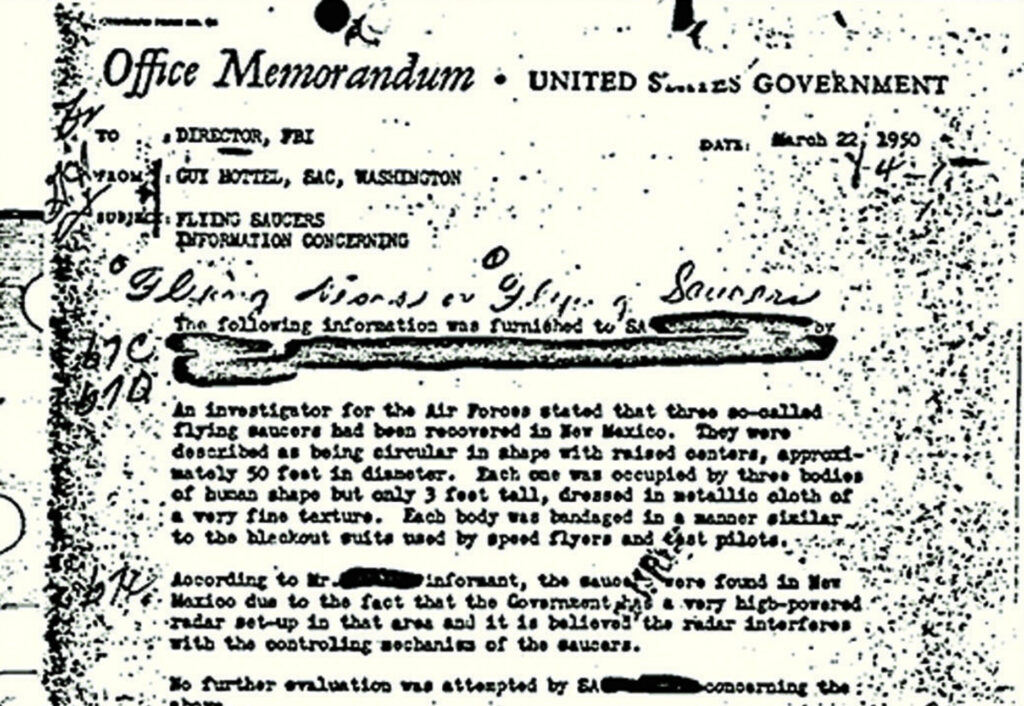
WASHINGTON, June 30 — The most-viewed document in the FBI’s online public reading room is not a counter-intelligence bombshell or a Mafia indictment. It is a 1950 memo from a Washington field office official, Guy Hottel, summarising a secondhand claim that several “flying saucers” with occupants had been recovered in New Mexico. The FBI has been clear about the file’s status for years: it is unverified, thirdhand information that was never investigated.
The detail that matters, and the one that keeps the document at the top of the digital charts, is that the Bureau itself says it has no operational value. Yet it sits there, a persistent ghost in the machine of public record.
The memo itself is a single page. It records a conversation Hottel had with an informant who, in turn, was relaying a story from a third party. The core of the tale — recovered craft and non-human occupants in New Mexico — predates the more famous Roswell incident by three years, though the geography overlaps.
The technical reality is that the document contains no evidence, no photographs, no serial numbers, no chain of custody. It is, under the hood, a piece of hearsay typed on official letterhead.
Why does it draw the most traffic? The FBI’s Vault reading room contains thousands of declassified files on organised crime, Cold War espionage, domestic terrorism, and public corruption. The Hottel memo, by contrast, is a curiosity that refuses to fade. It became the most-viewed file in the entire collection precisely because it offers so little — and that absence of resolution, as ever, feeds the loop.
There is no evidence the Bureau ever assigned an agent to verify the claim. No follow-up interviews, no field reports, no corroborating witness statements appear in the file.
The memo was simply filed and forgotten, until the digital age turned it into a phenomenon. The FBI has publicly noted the information is thirdhand and uninvestigated, a disclaimer that does little to slow the page views. For the informed reader, the Hottel memo is a case study in how institutional documentation can acquire a life of its own.
The document is real. The FBI released it.
But the substance of the claim is vapour. The Bureau’s own position — that it is unverified and was never pursued — is the only hard fact in the file. What to watch next: the Vault’s analytics will almost certainly keep the memo in the top spot, barring the release of a genuinely consequential file.
The FBI continues to declassify material under the Freedom of Information Act, but no single document has dislodged the Hottel memo from its peculiar throne. The detail that matters is that the Bureau has no plans to reinvestigate the claim.
The file is what it is: a piece of paper, a typed summary of a rumour, and the most popular document in the most powerful law enforcement agency’s public archive.




