
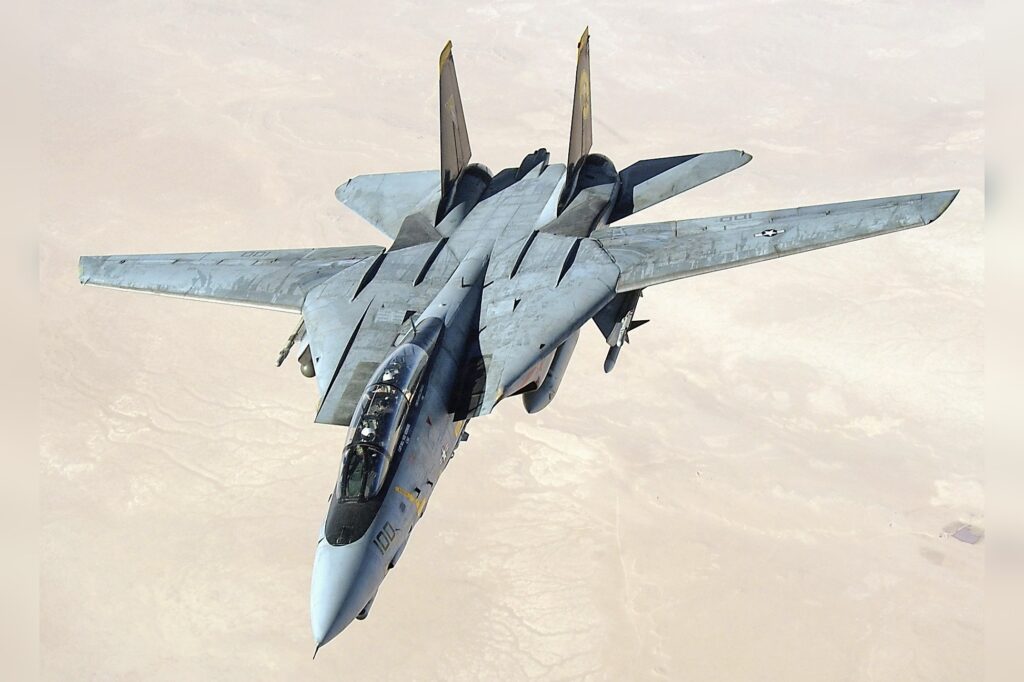
The Iranian F-14 Tomcat’s story did not begin with a bomb. It began with a Soviet reconnaissance jet that could outrun and outclimb anything in the sky. By the early 1970s, Moscow was exporting the MiG-25 Foxbat.
That aircraft could fly at over Mach 3 and above 80,000 feet. Iran’s air force, then called the Imperial Iranian Air Force, had nothing that could touch it.
The Shah of Iran wanted an answer. He asked Washington for the best fighter available. In 1972, President Richard Nixon agreed to offer Iran the latest American military technology.
The IIAF tested two aircraft: the F-14 Tomcat and the F-15 Eagle. The choice was not simple.
Both were superb machines. But the Tomcat came with a weapon no other fighter carried: the AIM-54 Phoenix missile. The Phoenix was a monster.
It was designed to kill Soviet bombers at ranges beyond 100 miles. It could track multiple targets at once. For Iran, facing the Foxbat threat, that capability mattered.
A single Tomcat could engage six incoming MiG-25s before they ever got close. The F-15 was a dogfighter.
The F-14 was a fleet defender. Iran chose the defender. In January 1974, Iran placed an order for 30 F-14s and 424 Phoenix missiles.
That order later grew to 80 Tomcats and 714 Phoenix missiles. Spare parts and replacement engines for ten years were included.
The total cost was enormous. Iran paid in oil money. The aircraft were state-of-the-art.
They had the AWG-9 radar, the most powerful airborne radar of its time. They could see enemy aircraft at 200 miles. The first Tomcats arrived in Iran in 1976.
They were parked on the ramp at Isfahan Air Base. In May 1978, an American HEXAGON reconnaissance satellite flew overhead and photographed the rows of gleaming new fighters.
They looked invincible. They were not. The Iranian Revolution came in 1979.
The Shah fled. The United States embassy was taken hostage.
Arms sales stopped. Spare parts dried up. The Tomcats, built to a standard of maintenance that required constant American support, began to cannibalize themselves.
Mechanics pulled parts from one aircraft to keep another flying. The fleet shrank. Then came the Iran-Iraq War.
The Tomcats fought. They shot down Iraqi MiG-21s, MiG-23s, and MiG-25s.
They used the Phoenix missile in combat, something the U.S. Navy never did. The Iranians claimed over 150 aerial victories. The exact number is disputed.
What is certain is that the Tomcats kept flying long after their expected service life ended. Iran reverse-engineered parts.
They built their own replacement components. They kept the aircraft in the air through sheer ingenuity. But the fleet continued to dwindle.
By the 2000s, perhaps 20 or 30 remained airworthy. The rest were kept as spare parts sources or sat derelict. Israel viewed the remaining Tomcats as a threat.
The aircraft could still carry the Phoenix missile. They could still reach Israeli aircraft.
Over the years, Israeli airstrikes targeted the base at Isfahan. Satellite imagery confirmed the destruction. The last of the Persian Cats are gone.
The story that began with a Soviet reconnaissance jet ended with wreckage on a ramp. Forty-eight years after that HEXAGON satellite photographed the new Tomcats, the ramp is empty.
The aircraft that once represented the height of American-Iranian alliance are dust. The Phoenix missiles are gone. The spare parts are gone.
The mechanics who kept them flying are old men now. The base at Isfahan is silent.




