
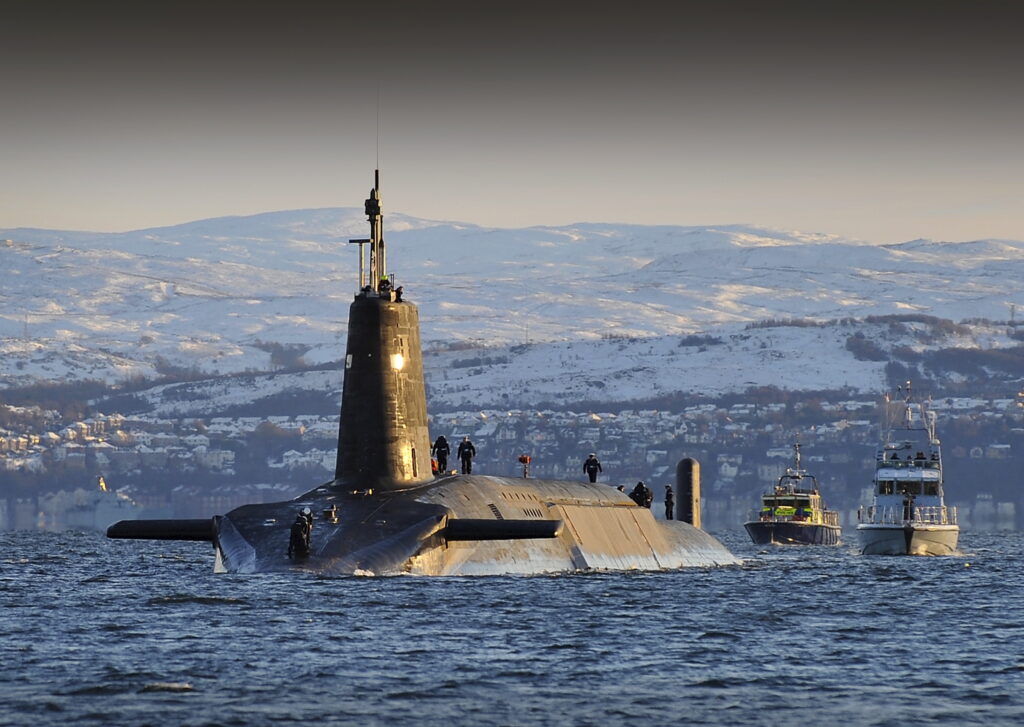
LONDON, September 29 — The United Kingdom’s pledge to extend its nuclear deterrent protection to Finland and other European allies, announced in March 2024, remains a political signal rather than a shift in operational or financial commitments, according to the original announcement. The UK’s strategic nuclear arsenal, based on the Trident missile system aboard Vanguard-class submarines, will be framed as contributing to NATO’s collective security under Article 5, though no nuclear weapons will be stationed on Finnish territory or placed under Finnish command.
The UK maintains a minimum deterrent posture of four Vanguard-class submarines, each capable of carrying up to 16 Trident II D5 missiles, with one submarine always on patrol. The UK’s nuclear stockpile is estimated at approximately 225 warheads, of which up to 120 are operationally available for deployment, according to the Federation of American Scientists and the UK government’s own disclosures.
The annual cost of maintaining the UK’s nuclear deterrent is estimated at £6 billion (about US$7.5 billion), covering warhead maintenance, submarine operations, and infrastructure at the Atomic Weapons Establishment in Aldermaston and the Clyde Naval Base in Scotland. Finland, which shares a 1,340-kilometer border with Russia, joined NATO on April 4, 2023, ending decades of military non-alignment. Its accession was driven by security concerns following Russia’s full-scale invasion of Ukraine in February 2022.
Finland’s defense budget for 2024 is set at €6.2 billion (about US$6.7 billion), representing roughly 2.3% of its GDP, in line with NATO’s target. The UK’s pledge does not involve new financial transfers or joint nuclear planning but serves as a political signal of solidarity.
Analysts note that while the UK’s nuclear deterrent has historically been oriented toward global strategic stability, its explicit linkage to Nordic and Baltic security reflects evolving alliance dynamics. No changes to the UK’s nuclear use policy or command structure were announced. The UK remains one of nine nuclear-armed states and the only NATO member besides the United States to possess an independent strategic nuclear deterrent.
France maintains its own separate force de frappe. The announcement coincided with broader NATO discussions on enhancing deterrence in Europe’s northern flank, including increased rotational deployments of troops and enhanced air policing in the Baltic region. The UK has contributed to NATO’s enhanced Forward Presence in Estonia and leads the Joint Expeditionary Force, a coalition of northern European nations.
Finland’s military operates under a doctrine of total defense, with a wartime strength of approximately 280,000 personnel supported by a reserve force of 900,000. The country maintains compulsory military service and has invested heavily in artillery, air defense, and cyber capabilities.
The UK’s nuclear pledge does not alter Finland’s non-nuclear status or its commitment to nuclear disarmament goals under the Nuclear Non-Proliferation Treaty, to which both countries are signatories. The statement was welcomed by NATO Secretary General Jens Stoltenberg as reinforcing alliance cohesion, though it drew criticism from some disarmament advocates who argue such commitments risk lowering the threshold for nuclear use. No specific timeline or operational details for the extension of deterrent coverage were provided beyond the political affirmation.
Going forward, watch for whether this political commitment translates into concrete planning, funding adjustments, or changes in NATO’s nuclear sharing discussions, particularly as northern flank defenses continue to be reinforced.




