
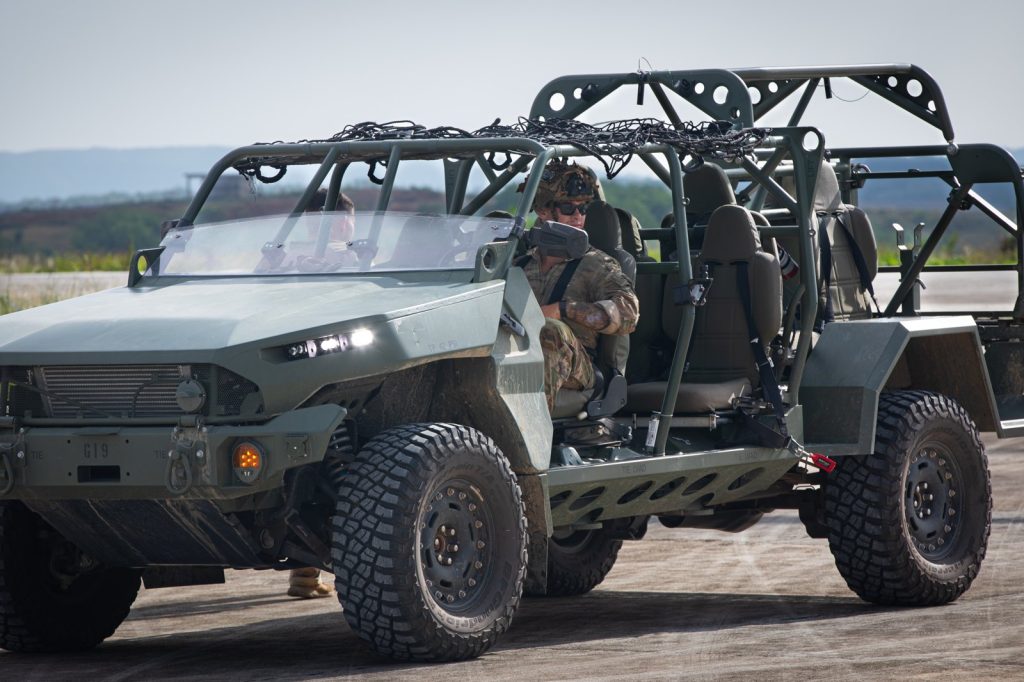
DETROIT, September 27 — General Motors’ defense arm has secured another Pentagon contract modification, and this one is larger than the previous agreement. GM Defense secured a $697.7 million contract modification to expand and upgrade its fleet of tactical military vehicles, the company announced on September 21, lifting the cumulative value of GM’s existing military vehicle agreement to $915.6 million. The money targets engineering work on the U.S. Army’s Infantry Squad Vehicle (ISV) programme and the winch kits that accompany it.
The modification integrates cold-weather and structural adjustments to the standard open-air design, adding a windshield, heater and defrost system, plus options for a full crew enclosure kit.
An open-air truck gets a roof, of sorts
The ISV is modelled on the civilian Chevrolet Colorado and is an ultralight, all-terrain vehicle capable of carrying up to nine troops along with their heavy combat gear. The programme was first awarded in 2020, with the Army buying a lightweight, air-transportable platform designed for rapid deployment and mobility in austere environments. The new engineering upgrades, GM says, address operational feedback from soldiers in the field — particularly on cold-weather performance and crew protection.
The winch kits improve recovery and utility. GM Defense expects to complete the expanded vehicle order by June 25, 2028.
The technical reality here is that an open-air squad carrier is a fine thing in the desert and a miserable one in a cold-weather environment. Adding a heater and defrost to a Colorado-derived chassis sounds mundane. It is also the sort of detail that decides whether a vehicle gets used or parked.
Missile housings in 22 days
The ISV award lands barely a week after a rather more striking piece of manufacturing news. On September 17, Lockheed Martin announced it had received its first critical precision-cast housing components for Patriot PAC-3 MSE interceptor missiles from GM. GM engineered and delivered those components in a 22-day turnaround — a rare bit of speed for a legacy automaker that normally measures development in model years.
The driver is the ongoing conflict with Iran, which has depleted domestic U.S. missile stockpiles and prompted emergency domestic production efforts. That has pushed the Pentagon toward traditional automotive manufacturers to supplement defense production capacity, a trend accelerated by global conflicts and the need to replenish U.S. military stockpiles.
GM’s 22-day delivery positions it as a primary player in that emergency supply chain. As ever, the detail that matters is capacity. Casting houses are not something you conjure in a quarter, and the fact that an automaker could turn precision-cast housings around in three weeks says as much about idle automotive tooling as it does about GM’s engineering.
The Barra hedge
Both developments serve a strategy GM CEO Mary Barra has been pushing with some discipline: scaling the high-margin military business to insulate the automaker from the cyclical nature of consumer vehicle sales. Defense work offers better margins and less cyclical demand than selling pickup trucks to civilians. Investors noticed.
GM shares (NYSE: GM) ticked up roughly 1% in early trading after the announcement and closed the tracking week at $82.63, a gain of 2.56%. The Pentagon, for its part, has been steadily diversifying its supplier base, and the twin September developments — the ISV upgrade contract and the missile-component delivery — underscore GM’s expanding role in defense manufacturing.
GM Defense is now positioned to capture additional contracts as the Army modernises its fleet and the Defense Department replenishes munitions. What to watch next is whether the 22-day turnaround becomes a repeatable capability or a one-off sprint. The ISV deliveries are due by June 25, 2028; the missile-component pipeline has no such public deadline, which is precisely the sort of gap that tends to get filled quietly.




