
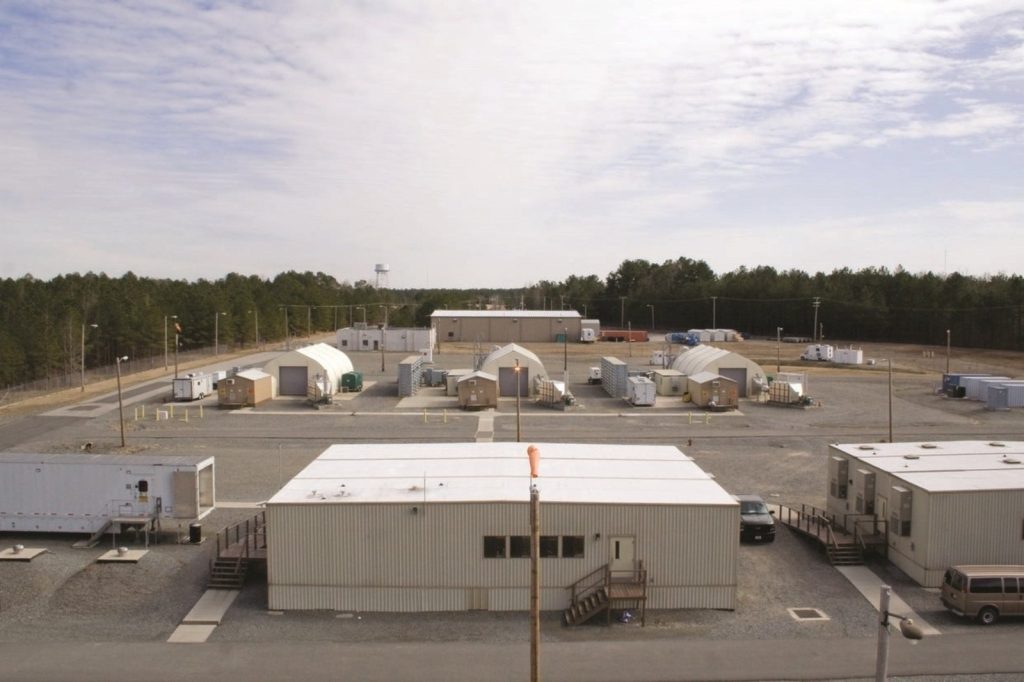
WHITE HALL, September 21 — Hanwha Defense USA will build its first United States artillery ammunition factory at Arkansas’ Pine Bluff Arsenal, a $2.2 billion plant the South Korean contractor says will create about 400 jobs at an average wage of $50 per hour over seven years.
The announcement came Monday at a news conference and ribbon-cutting in White Hall marking the opening of new administration headquarters — the first physical step in a munitions campus project that began when the Army awarded Hanwha a lease solicitation for the arsenal in January. Under the hood, the product list is narrow and specific: propellant charges and base bleed units for 155-millimeter ammunition, according to a Hanwha news release.
Those are the components that sit between the shell and the target — the charge that throws it, and the unit that extends its reach. CEO Michael Coulter framed the output in terms the Pentagon has been using all year. The company’s production “will enhance the speed and range” of the U.S. Army’s weaponry, he said, at a moment when the federal government is pushing industry to replenish stockpiles depleted by the war in Iran.
“Our goal is to maximize automation to ensure safe manufacturing and enhanced quality,” Coulter said. “The idea is to transform Pine Bluff Arsenal into a modern asset that advances both national defense priorities and U.S. Army priorities, including readiness that protects America’s warfighter.” Automation is the detail that matters here.
Propellant handling is among the more hazardous jobs in munitions work, and a plant designed around automated lines rather than manual loading is a different proposition from the legacy facilities the Army has been running.
The politics and the money
Gov. Sarah Huckabee Sanders called the investment “the kind of transformational investment Jefferson County and the Delta need.” It is not the only one. Arkansas Commerce Secretary Hugh McDonald said the Hanwha factory is one of four capital investment projects, totaling $6 billion, planned for Jefferson County over the next three to five years.
Jordan Gillis, Assistant Secretary of the Army for Installations, Energy and Environment, said Hanwha’s choice of Pine Bluff “represents what can happen when Army and industry and our local communities come together around a shared objective.” The state’s business discussions with Hanwha began in March 2024, with help from U.S. Rep. Bruce Westerman and U.S. Sens. Tom Cotton and John Boozman, all Republicans.
Those talks continued in May 2025, when the three traveled to Japan, Taiwan and South Korea with the goal of “convincing people that this is the arsenal of the future,” said Westerman, whose district includes Jefferson County. Sanders said she met with Hanwha leaders in July at the Farnborough International Airshow in England, part of a three-country overseas trade mission.
Cotton, in the Hanwha release, said the facility “remains a key national security asset that is ripe for greater defense investment.” Westerman was seen chatting with Col. Matthew Mason, commander of the Pine Bluff Arsenal, before the news conference at the Army facility.
A regional pattern, not a one-off
South Arkansas has become a defense contracting hub. The 2,000-acre L3Harris arms manufacturing campus in East Camden produces more than 115,000 rocket motors per year. The region is also home to a $33 million missile plant, a joint venture Raytheon Technologies and Israel-based Rafael Advanced Defense Systems announced in October 2023.
In February, Defense Secretary Pete Hegseth praised Arkansas’ munitions industry at the L3Harris plant as part of a national speaking tour. The Pine Bluff Arsenal itself was built in 1941, the same year the United States entered World War II — an eighty-five-year-old installation now being retooled around a Korean contractor’s production line.
What to watch next is whether the January lease solicitation converts into a signed agreement and a construction start, and whether the other three Jefferson County projects McDonald referenced come with the same level of public detail. The 400 jobs and the $50 hourly average are the numbers Hanwha has put on the record. The rest is still on paper.




