
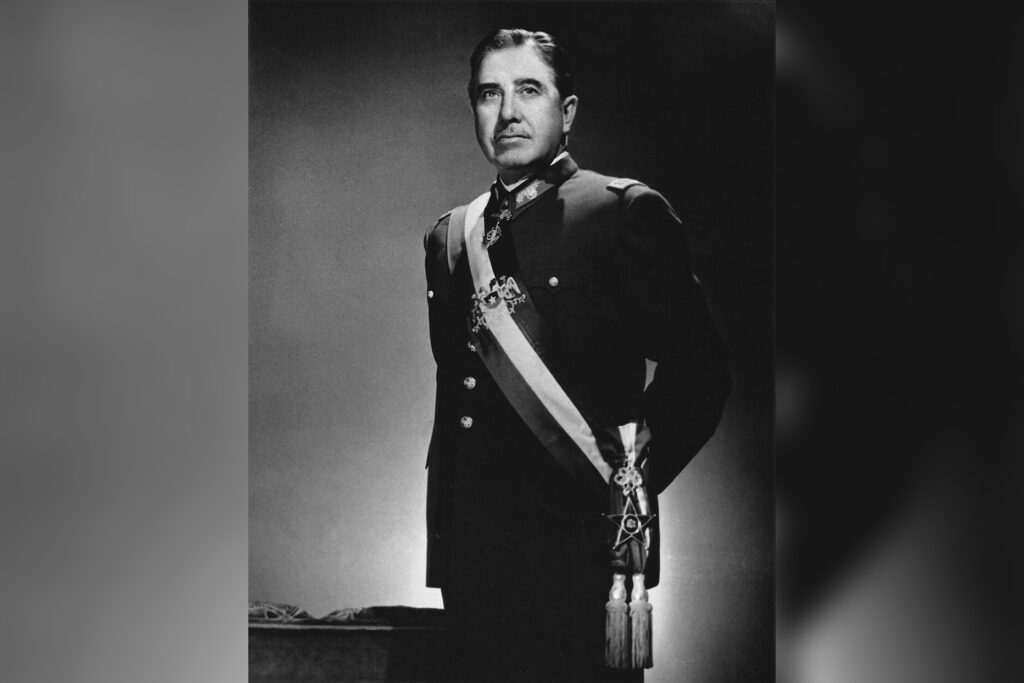
WASHINGTON, September 22 — The National Security Archive has posted newly declassified FBI documents on the renewed “major case” investigation into General Augusto Pinochet’s role in the 1976 car bombing that killed former Chilean ambassador Orlando Letelier and his colleague Ronni Karpen Moffitt, marking the fiftieth anniversary of the attack. The bomb detonated on the morning of September 21, 1976, planted under the chassis of Letelier’s car as he and his colleagues drove to work along Massachusetts Avenue’s Embassy Row.
Letelier had served as President Salvador Allende’s ambassador to Washington and as minister of defense before the coup. Moffitt, a fundraiser at the Institute for Policy Studies, where both worked, was killed in the blast.
Her husband, Michael Moffitt, Letelier’s research assistant, was the sole survivor.
The CHILBOM File
The documents surfaced through Freedom of Information Act requests filed more than a decade ago by the Archive’s Chile Documentation Project. The renewed FBI and Department of Justice investigation, codenamed CHILBOM, was authorized by Attorney General Janet Reno on February 8, 1999 — several months after Pinochet was detained in London on an Interpol warrant filed by Spain under the European Anti-Terrorism Convention.
One FBI overview states the objective was to determine whether sufficient admissible, credible evidence exists to establish that one or more additional persons, up to and including General Augusto Pinochet, was involved in the homicides. A March 27, 2000, FBI report puts it plainly: “There are still unsolved aspects of the case.
The intellectual authors of the crime are still being sought, and this may lead to the highest levels of the former Chilean government, which at the time of the bombing was led by General Augusto Pinochet.” Under the hood of the file sits an interview. In a meeting with FBI agents on May 25, 2000, in New York, former secretary of state Henry Kissinger related a private meeting he had with Pinochet in Santiago three months before the assassination.
According to the newly disclosed FBI summary, “Kissinger recalled Pinochet bringing up Orlando Letelier’s name when he referenced contact which was being made by Christian Democrats and opponents to the Pinochet regime with members of the US congress. Kissinger could not recall if Pinochet became angry when speaking of Orlando Letelier.”
The Condor Lead
Within seven days of the bombing, FBI attaché in Buenos Aires Robert Scherrer developed a lead from an Argentine intelligence source on Operation Condor, a collaboration between Southern Cone secret police agencies to track and eliminate opponents.
In a September 28, 1976, intelligence cable, Scherrer reported: “Chile is the center for ‘Operation Condor.’ It is not beyond the realm of possibility that the recent assassination of Orlando Letelier in Washington, D.C. may have been carried out as a third phase action of ‘Operation Condor.’” For almost twenty years this cable was the only publicly available document connecting Chile to the assassination. It was first obtained and cited by investigative journalist John Dinges, co-author with Saul Landau of Assassination on Embassy Row, the first book on the case.
It took almost two years for the FBI to concretely identify the Chilean secret police, DINA, as responsible. A break came after photographs of two Chilean operatives who, under Condor, had sought false visas in Paraguay for a mission to the United States in August 1976, were published on the front page of a Washington, D.C., newspaper. Within hours they were identified as DINA agents: American-born Michael Townley and Major Armando Fernandez Larios.
The Carter administration demanded Townley, a U.S. citizen, be transferred into U.S. custody. After months of delay, the Pinochet regime turned him over to the FBI, but only after U.S. authorities agreed not to question him about DINA operations other than the Letelier mission.
Based on Townley’s detailed confessions on DINA’s responsibility, the Department of Justice indicted DINA director Col. Manuel Contreras and his deputy, Pedro Espinoza, along with Fernandez Larios. The U.S. filed formal extradition requests to Chile, generating what one member of Pinochet’s military junta called “a Chilean Watergate.” At that point, General Pinochet spearheaded a major cover up of his and DINA’s role, according to the source material.
The Archive’s posting is edited by Peter Kornbluh, author of The Pinochet File (The New Press, updated edition September 11, 2013) and Pinochet desclasificado (Un Dia en La Vida/Editorial Catalonia, August 2023). Dinges also wrote The Condor Years (The New Press, August 1, 2012) and Los años del Cóndor (DEBATE, June 1, 2021).
What to watch next: whether the CHILBOM file yields further releases, and whether the Archive’s fifty-year push




