
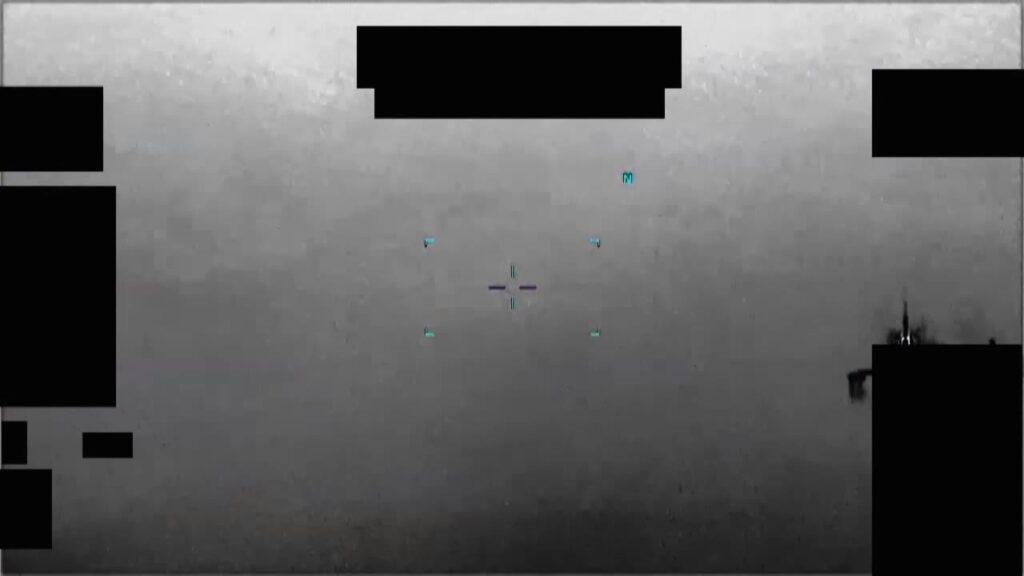
The Department of War has made public a declassified video recording of an unidentified anomalous phenomenon, or UAP, captured on June 1, 2020. The footage, cataloged as PR59 under the Pentagon’s PURSUE policy framework, was released by the All-domain Anomaly Resolution Office (AARO) as part of its commitment to increasing transparency regarding such incidents. The recording, identified by the filename “dow-uap-pr059-nag-uap-1-jun-20,” was obtained by a sensor aboard a U.S. Navy platform operating at an undisclosed location.
While technical details in the filename suggest the platform was a naval asset, the specific type of vessel or aircraft and its location have not been disclosed. The video depicts a small, fast-moving point of light against a clear sky, displaying no visible propulsion system or aerodynamic surfaces.
Sensor data accompanying the footage includes infrared and radar tracks, though the object itself remains unidentified. This release follows the implementation of the PURSUE policy by the Department of War, which standardizes how UAP incidents are reported, collected, and analyzed across all military branches. AARO, established under the Office of the Secretary of Defense, oversees these operations.
The video was declassified after a review concluded that its release would not compromise sensitive sources or methods. The report does not indicate whether the object demonstrated capabilities beyond those typical of known aircraft or drones.
Its recorded speed and maneuverability align with patterns seen in previous UAP reports, but the analysis has not reached a definitive conclusion. The Department of War has not linked the object to any foreign adversary or natural phenomenon. This marks the latest in a series of declassified UAP videos released by the Pentagon since 2020.
Earlier releases included footage from 2015 and 2019, which depicted objects with unusual flight characteristics. Under the PURSUE framework, such incidents must be reported to AARO, which maintains a centralized database for analysis.
The office can now request additional data from the platform’s operators, including radar logs, maintenance records, and eyewitness accounts. Personnel present during the encounter may also be interviewed. Further analysis could involve collaboration with other government agencies or academic institutions to rule out conventional explanations.
The release is part of a broader effort by the Department of War to address UAP reports transparently while safeguarding national security. AARO continues to evaluate similar incidents and will provide updates as new information becomes available.




