
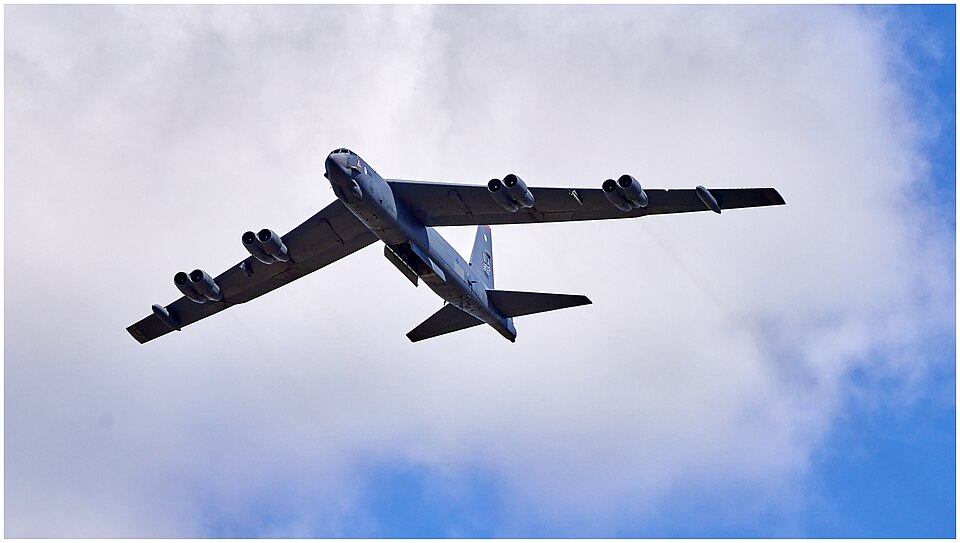
WASHINGTON, September 12 — The Government Accountability Office has examined all thirteen programmes inside the US Air Force’s roughly twenty-one-billion-dollar B-52 modernisation effort and found ten of them running over cost, behind schedule, or short on performance, according to a report published earlier this summer. The watchdog’s verdict on the Stratofortress fleet is blunt.
“The scope of the cumulative B-52 modernization effort, combined with the inherent complexity associated with simultaneously executing multiple independent and concurrent programs, results in technical, programmatic, and operational challenges for the entire community tasked to develop, integrate, test, and field these upgrades,” the GAO report stated. Ten out of thirteen.
That is the detail that matters.
The engine bill
The largest single contributor to the overrun is the Commercial Engine Replacement Program, or CERP, which will strip the eight Pratt & Whitney TF33 engines off each bomber and replace them with Rolls-Royce F130 engines — a military variant of the 16,900lb-thrust BR725 turbofan that powers the Gulfstream G650ER business jet. CERP was budgeted at roughly three billion dollars. It now stands at about fifteen point four billion, more than five times the original figure, and initial operational capability has been delayed by fifteen months.
Under the hood, the price growth and the delay reflect a deliberate choice by the US Air Force to move toward production with minimal developmental flight testing — a decision the GAO’s findings suggest risks further cost increases and schedule delays. CERP has, at least, passed a critical design review milestone that validated the Rolls-Royce F130.
Radar and cockpit
The Radar Modernization Program has grown from about two point three billion dollars to two point nine billion, triggering a Nunn-McCurdy breach — the statutory mechanism that forces the Pentagon to justify a programme to Congress once cost growth crosses defined thresholds. Boeing’s work on that programme has seen two test aircraft outfitted with an APQ-188 active electronically scanned array radar system that the company says is broadly similar to the AN/APG-79 radar equipping Boeing F/A-18E/F Super Hornets and EA-18G Growler electronic attack jets.
Troy Dawson, vice president of Boeing Bombers, said: “The new radar will significantly increase B-52 mission effectiveness by improving situational awareness, speeding target prosecution and enhancing aircrew survivability in contested environments. This phase of the program is dedicated to getting it right at the start so that we can execute the full radar modernization program.” The effort will also integrate a pair of Display and System Sensor Processors into the B-52’s radar, as well as a pair of touchscreens and what Boeing describes as “fighter-like hand controllers” for radar operation.
The B-52 Stratofortress, the workhorse of the United States nuclear deterrent against the Soviet Union, is the oldest bomber in the United States Air Force and is set to keep flying into the middle of this century, and potentially beyond. Though the ongoing upgrade efforts are likely to succeed from a capabilities standpoint, they still face looming pitfalls, including significant cost overruns.
What to watch next is whether the Air Force’s bet on minimal developmental flight testing for CERP holds up once the F130s are actually mounted on the wings — and whether the Nunn-McCurdy breach on the radar programme forces the service to restructure the wider modernisation plan before the fleet’s next major milestone.




