
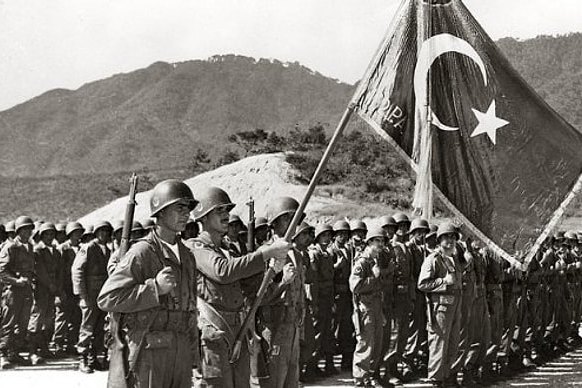
ANKARA, September 1 — The NATO leaders’ summit that closed here in July was about the alliance’s present and future, but the declassified files dusted off for the occasion tell a stranger story from its past. Military anthropologist Dr Ece Aynur Onur has pulled from the US National Archives the interrogation records of 244 Turkish soldiers captured during the Korean War — and the Pentagon’s subsequent, fundamental reassessment of how its own troops should behave in captivity.
Türkiye sent thousands of troops to fight under the United Nations flag in Korea in 1950, a commitment that strengthened its bid for NATO membership, secured in 1952. The captured men, held in Chinese and North Korean prisoner-of-war camps, turned silence into a weapon.
As Onur puts it, “The core doctrine of the Turkish POWs was absolute silence and the preservation of national secrets.” The interrogators came to call them the “Silent Turk.” The files centre on Captain Ihsan Serim, one of the two highest-ranking Turkish officers captured during the war. Classified by the US military in 1955, the records were declassified following Onur’s request in 2017.
Serim was captured near the Imjin River on April 23, 1951, and forced onto a death march alongside 200 captive UN soldiers, walking twelve to fourteen hours every night. He was transferred to Camp 2 near Pyoktong, where Turkish, British and American officers were held together.
The technical reality of his resistance is remarkable. In March 1952, facing a Chinese lieutenant colonel and a Russian interpreter fluent in Turkish, Serim told them they could execute him if they wished, but he would never compromise his country or reveal military secrets. The pressure triggered debilitating migraine attacks; after being taken unconscious into surgery and waking with a deep incision above his left eyebrow, the headaches vanished.
He then fed his captors entirely fictional written statements to mislead Chinese intelligence, and was eventually returned to the general population. The detail that matters is how the resistance held up under interrogation. Captain Hamit Yuksel convinced his captors he was an ageing, incompetent infantry officer, using fabricated but internally consistent answers.
Chinese interrogators, led by an officer identified in the files as Malik, were attempting to extract intelligence on Turkish force structures and battlefield tactics. Serim attempted an escape on Christmas Eve 1952, was recaptured, and spent ten days in solitary confinement before months of intensive questioning.
The Pentagon’s interest was pragmatic. Studying how Turkish prisoners maintained discipline under extreme conditions — and noting that none died inside permanent POW camps — US military planners fundamentally reassessed their approach to captivity. The records, as ever, say more about the observers than the observed: an American military establishment watching allied soldiers resist, and rewriting its own doctrine on that evidence.
What to watch next is whether Onur’s work prompts further declassification requests. The Serim and Yuksel files are now public; the broader record of how the Pentagon applied those Korean War lessons to its own captivity doctrine remains, for now, under the hood.




