
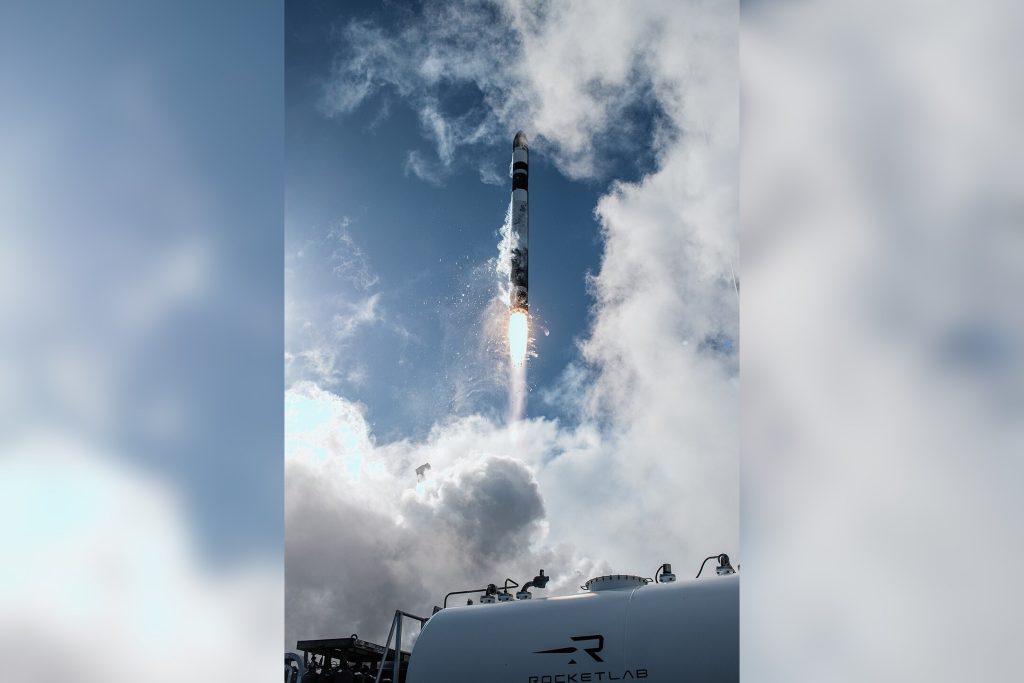
Rocket Lab’s HASTE launch vehicle is conducting hypersonic test missions for the Pentagon, marking a significant expansion into defense contracts. The company secured a $190 million, 20-launch agreement with the U.S. military earlier this year as part of its MACH-TB program, designed to streamline hypersonic flight testing.
This initiative, which involves collaboration with Kratos, aims to replace ground-based or missile-derived testing with real-world suborbital flights. HASTE, built on Rocket Lab’s Electron vehicle, features a carbon-composite structure and 3D-printed engines, enabling rapid iteration and deployment. The Pentagon has prioritized hypersonic systems, which travel faster than Mach 5 and maneuver in the upper atmosphere, as critical to national security.
Unlike traditional methods, HASTE allows for repeatable flight tests, offering more accurate simulations of threat scenarios. In late June, Rocket Lab received a $266 million contract from the U.S. Space Force for up to 18 suborbital missile defense launches.
This is the largest launch contract in the company’s history. To support these missions, Rocket Lab deployed its GHOST technology, which packages launch infrastructure and ground systems into portable shipping containers. This innovation allows the company to establish launch sites in remote areas quickly, reducing setup time from years to months.
The Virginia-based operations further expedite integration and testing, aligning with the Pentagon’s demand for agile solutions. Beyond launch services, Rocket Lab’s space systems business is also securing defense contracts.
In August, the company won a $397 million deal with the U.S. Space Force to develop and operate Flatellite spacecraft under the SB-AMTI program. These flat satellites are optimized for large constellations, reflecting Rocket Lab’s vertically integrated approach to space. Additionally, partnerships with Raytheon and Viasat highlight its expanding role in space-based defense.
Raytheon’s Golden Dome Space-Based Interceptor program and Viasat’s Protected Tactical SATCOM-Global initiative both involve Rocket Lab’s satellite components, underscoring its growing influence in military technology. The defense pivot has stabilized Rocket Lab’s revenue.
Historically, launch providers faced cyclical demand and irregular income. Government contracts, however, offer predictable, long-term funding. This shift has diversified the company’s income streams, reducing reliance on commercial launches.
The $8 billion acquisition of Iridium Communications further strengthens this strategy. Iridium’s 66-satellite constellation and L-band spectrum provide weather-resilient communications, offering an alternative to GPS and enhancing Rocket Lab’s defense capabilities.
For investors, Rocket Lab represents a unique intersection of space and defense. The company’s integrated platform allows it to bid on complex government contracts while maintaining margins. As defense budgets grow and space becomes a national security priority, Rocket Lab’s dual focus on launch and space systems positions it for sustained growth. The recent contracts and Iridium deal signal a company adapting to evolving security needs, blending technical precision with strategic expansion.




