
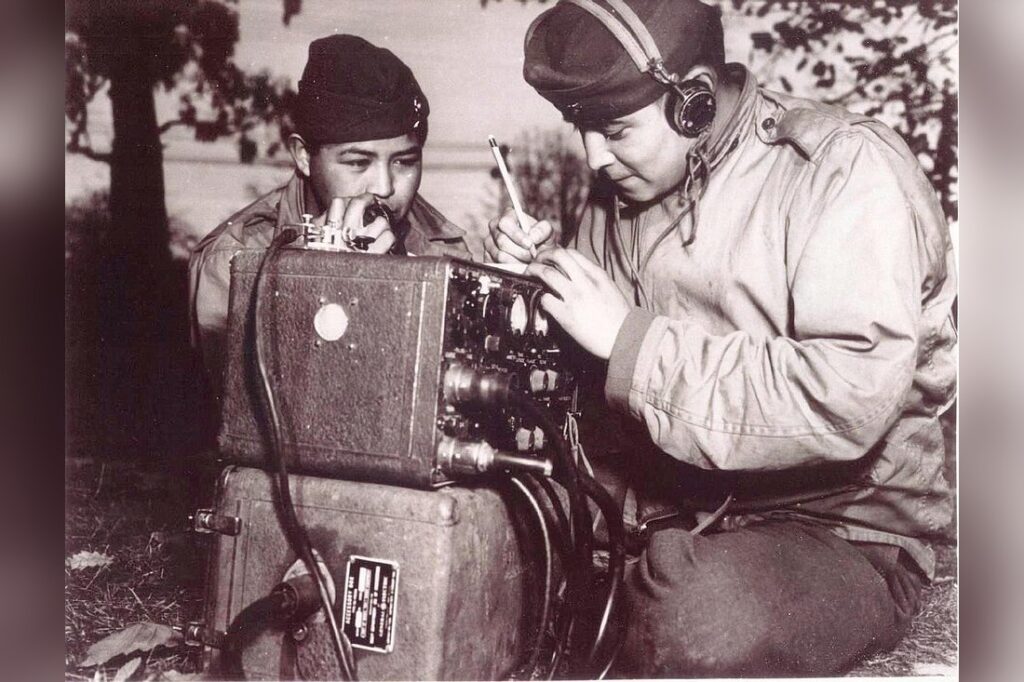
Phoenix, August 20 — A commemorative event honoring the Navajo Code Talkers is set to take place in Phoenix. The gathering will mark the anniversary of President Ronald Reagan’s proclamation designating August 14 as Navajo Code Talkers Day. At the heart of the event is Thomas H.
Begay, one of the last surviving veterans of the program. Begay, who served during World War II, will share his experiences as one of the original 29 Navajo men who developed the secret code that played a pivotal role in U.S. military victories in the Pacific.
The Navajo Code Talkers, recruited by the U.S. Marine Corps between 1942 and 1945, created a communication system based on their unwritten language. This code, which remained classified for decades, involved translating complex battlefield information into Navajo phrases. The system proved nearly unbreakable to Japanese forces, frustrating enemy efforts to decode messages.
According to Dawn Manuelito, granddaughter of one of the first 29 Code Talkers, the code was critical to turning the tide of the war. “The U.S. was being defeated,” she said, “without this system.” Manuelito emphasized that the code’s effectiveness stemmed from the Navajo language’s complexity and cultural uniqueness, which the Japanese never deciphered.
The program’s scale was significant for its time. Over 400 Navajo men participated in developing and executing the code, transmitting thousands of secret messages during the war. These messages covered tactical movements, troop positions, and other sensitive information.
The military’s reliance on the Navajo language saved thousands of Allied lives, Manuelito noted. The code’s secrecy was maintained through rigorous training and the inherent difficulty of the Navajo language, which lacked a written form and had a complex syntax that defied translation.
The Lasting Legacy of a Secret Language
Efforts to preserve the legacy of the Code Talkers have gained momentum in recent years. While the original code was declassified in the 1960s, its impact is still felt in modern military communications. The Phoenix event is part of a broader initiative to educate the public about the Navajo Code Talkers’ role in World War II.
Local historians and veterans’ groups have organized workshops and exhibitions to ensure the story is not forgotten. For Manuelito, the event is a chance to honor her grandfather’s service and to share his story with a new generation.
Despite the passage of time, the Code Talkers’ story continues to captivate. Begay, now in his 101st year, remains a living testament to their courage. His participation in the Phoenix event underscores the enduring bond between the Navajo Nation and the U.S. military.
“The code was more than a tool,” Manuelito said. “It was a symbol of resilience and ingenuity.” The event will also include a moment of silence for the Code Talkers who died in service, a reminder of the human cost behind their achievements.
As the commemorative event approaches, questions linger about how to best honor the Code Talkers’ legacy. Some advocates argue for increased recognition of their contributions in official U.S. military histories. Others push for broader acknowledgment of indigenous service members in wartime narratives.
For now, the Phoenix gathering represents a focal point for reflection. Begay’s presence ensures that the voices of the past will not be silenced. “We are here to tell our story,” he said.
“And to make sure it is remembered.”




