
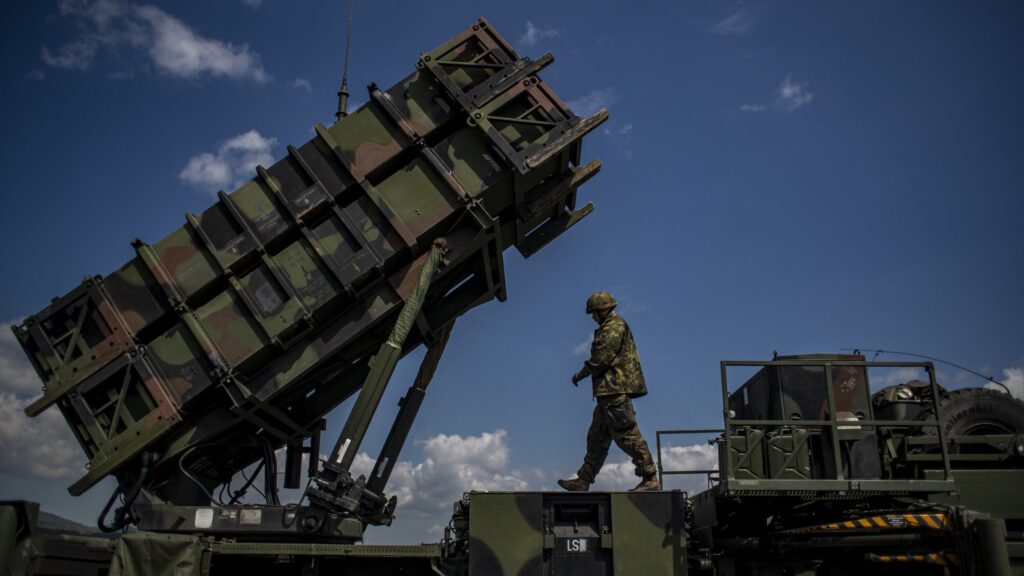
WASHINGTON, August 8 — The MIM-104 Patriot, a surface-to-air missile system first fielded by the U.S. Army in 1981, has become a defining tool in Ukraine’s air defense arsenal, with its latest iterations now locking horns with some of Russia’s most advanced munitions. The system’s origin traces back to the 1960s, a Cold War-era project that evolved into a multi-layered shield against aircraft and, later, ballistic missiles. Manufactured by Raytheon, the Patriot has seen repeated upgrades, most notably the PAC-2 and PAC-3 variants.
The PAC-3, in particular, was engineered to counter tactical ballistic missiles, a capability that has since been tested in real combat over Ukrainian skies. At its core, the Patriot is a networked beast.
A phased-array radar scans the horizon, feeding data to a central control station, while power generators and launcher stations complete the battery. Each setup can engage multiple targets at once—a critical feature when facing saturation attacks. The interceptors themselves, such as the PAC-3 Missile Segment Enhancement (MSE), are no slouch either.
They boast a reported range of 160 kilometers and can climb to altitudes of 30 kilometers, putting them in the path of high-speed threats.
The Ukrainian Theater
Ukraine received its first Patriot battery from the U.S. in December 2022. Germany and the Netherlands followed suit in 2023, bolstering Kyiv’s ability to contest Russian air superiority. The system’s value became undeniable in May 2023, when Ukraine claimed its first successful intercept of a Russian Kinzhal missile—a hypersonic weapon traveling at speeds exceeding Mach 5.
The Patriot’s ability to track and down such a target marked a turning point in the conflict’s aerial dimension. But the mechanics here come with a cost.
Each interceptor carries a price tag of approximately $4 million, and a single Patriot battery demands a crew of around 90 personnel to operate it. The U.S. had previously supplied Ukraine with interceptors in batches, but the shift to a monthly delivery commitment addresses a harsh reality: the high expenditure rate of interceptors during sustained Russian airstrikes. The new approach ensures a steadier resupply, a logistical necessity when facing an adversary willing to saturate defenses with sheer volume.
Follow the Money
Raytheon’s role as the manufacturer places it at the center of a lucrative, if high-stakes, supply chain. The Patriot’s longevity—spanning decades of upgrades—reflects both its adaptability and the U.S. defense industry’s knack for extending the lifespan of proven systems. For Ukraine, the system is less about industrial profit and more about survival.
The catch is that every intercept depletes a finite stockpile, and every Kinzhal downed represents a multi-million-dollar expenditure. On closer reading, the Patriot’s deployment in Ukraine reveals a broader strategy.
The U.S. and its allies are not merely shipping hardware; they are investing in a layered defense that forces Russia to recalculate the cost-benefit ratio of its missile campaigns. The Kinzhal, once touted as unstoppable, now faces a credible counter. Yet the equation is delicate.
The more Ukraine relies on Patriots, the more it leans on Western resupply chains—and the more it tests the limits of those systems’ production and delivery capacity. What to watch next: whether the monthly interceptor deliveries can keep pace with Russia’s willingness to expend its own high-end munitions.
If the Patriot’s track record holds, the next phase may hinge on whether the West can sustain the flow of both missiles and the personnel required to keep them in the fight.
Sources
{“@context”: “https://schema.org”, “@type”: “NewsArticle”, “headline”: “How Patriot Missile Systems Strengthen Ukraine’s Air Defense”, “description”: “WASHINGTON, August 8 — The MIM-104 Patriot, a surface-to-air missile system first fielded by the U.S. Army in 1981, has become a defining tool in…”, “datePublished”: “2026-08-08T09:30:00+00:00”, “author”: {“@type”: “Person”, “name”: “Beatrice Ferrari”}, “publisher”: {“@type”: “Organization”, “name”: “InfoPulse Today”, “url”: “https://newsfeed.2bme.xyz/”}, “citation”: [{“@type”: “CreativeWork”, “url”: “https://en.wikipedia.org/wiki/MIM-104_Patriot”}]}




