
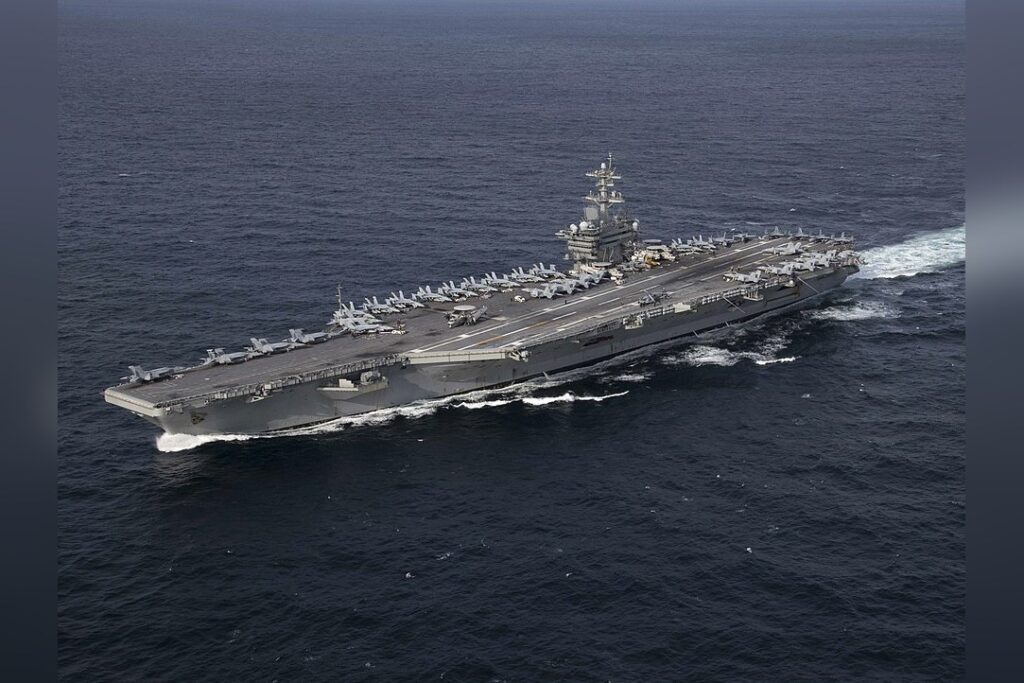
WASHINGTON D.C., August 1 — Two years ago, the USS Abraham Lincoln, a Nimitz-class nuclear-powered aircraft carrier, became the formidable centerpiece of one of the largest U.S. naval force movements to the Middle East since the 2003 Iraq War invasion. This massive deployment, ordered on August 2, 2024, signaled Washington’s deep anticipation of a possible large-scale regional conflict, a scene that remains etched in the memory of those monitoring the region.
U.S. Secretary of Defense Lloyd Austin issued the order for a significant military buildup in the Middle East. The directive explicitly aimed to protect U.S. forces already on the ground and to assist in the defense of Israel, coming amid escalating threats of Iranian retaliation. The USS Abraham Lincoln (CVN-72) and its accompanying strike group were ordered to either replace or augment the USS Theodore Roosevelt (CVN-71) carrier strike group, which was already operating within the Central Command area of responsibility.
The Pentagon’s strategic dispatch included more than just the carrier. The USS Georgia (SSGN-729), an Ohio-class guided-missile submarine, was also moved into the region. According to the U.S. Navy, this submarine is capable of carrying up to 154 Tomahawk land-attack missiles, a significant projection of precision strike capability. An unspecified squadron of F-22 Raptor fighter jets, fifth-generation stealth aircraft typically based at Langley Air Force Base in Virginia, were also deployed, capable of worldwide operations. The Pentagon’s public statement at the time described these movements as intended to “blunt” any potential attack and “deter” adversaries in the volatile region.
This August 2024 order built upon earlier, substantial measures. In late July 2024, the Department of Defense had already moved an additional squadron of F-35 fighters and the USS Wasp Amphibious Ready Group, which included 2,200 Marines, into the eastern Mediterranean. The layered deployments painted a stark picture of rising tensions.
Defense officials described the August 2 order as a direct response to the assassinations of Haniyeh and Shukur. These events had dramatically heightened the risk of a multi-front war, potentially involving Iran, Hezbollah, and various Lebanese proxies. The USS Abraham Lincoln, commissioned in 1989, carries up to 90 aircraft and more than 5,000 sailors, making its presence a powerful, visible statement of U.S. resolve.
The sheer scale of this deployment, echoing the strategic movements seen before the 2003 Iraq War, underscores the gravity with which Washington viewed the threats of two years ago. The ongoing implications of such a significant show of force continue to shape regional dynamics and the delicate balance of power across the Middle East.
Sources
{“@context”: “https://schema.org”, “@type”: “NewsArticle”, “headline”: “Pentagon Orders Middle East Buildup With Carriers And Submarine”, “description”: “WASHINGTON D.C., August 1 — Two years ago, the USS Abraham Lincoln, a Nimitz-class nuclear-powered aircraft carrier, became the formidable centerpiece of one of the…”, “datePublished”: “2026-08-01T09:30:00+00:00”, “author”: {“@type”: “Person”, “name”: “Isabella Moore”}, “publisher”: {“@type”: “Organization”, “name”: “InfoPulse Today”, “url”: “https://newsfeed.2bme.xyz/”}, “citation”: [{“@type”: “CreativeWork”, “url”: “https://en.wikipedia.org/wiki/USS_Abraham_Lincoln”}]}




