
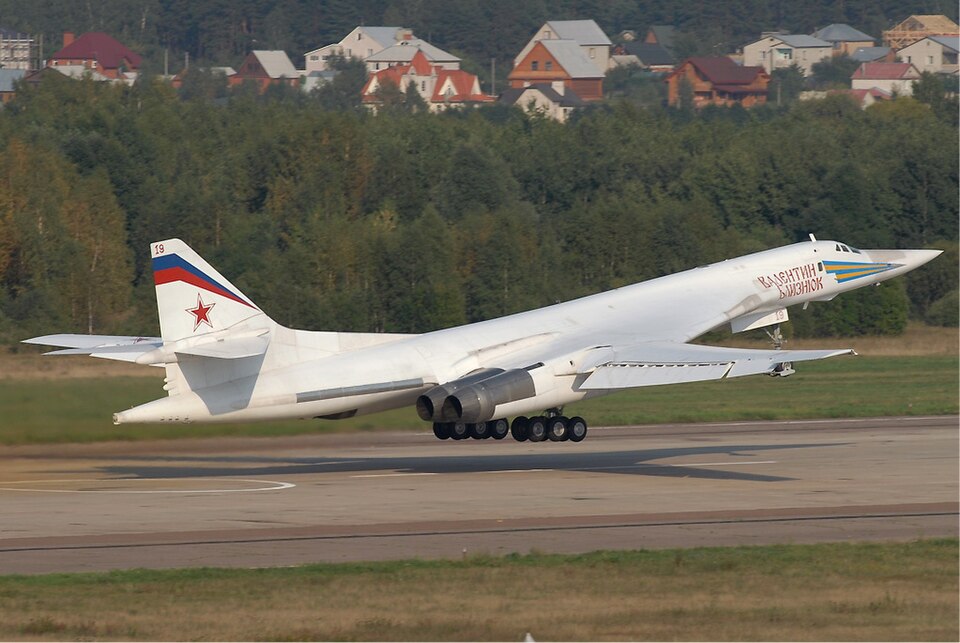
MOSCOW, July 25 — The Tupolev Tu-160 strategic bomber, known to NATO as the Blackjack, remains a central pillar of Russia’s long-range aviation capability, even as its combat record and modernization efforts continue to shape its geopolitical role. The aircraft, a product of the late Soviet era, was designed as a direct counter to the United States Air Force’s B-1 bomber program, with the Tupolev Design Bureau’s “Aircraft 160M” design accepted in 1972.
The Tu-160 made its first flight on December 18, 1981, after being photographed at Zhukovsky Airfield a month earlier. Production authorization came in 1984, with final assembly at the Kazan Aircraft Production Association (KAPO).
It entered service in 1987, making it the last strategic bomber built for the Soviet Air Forces. With a length of 54 meters and a wingspan that extends to 56 meters when spread—narrowing to 36 meters when swept back—the bomber can reach speeds of Mach 2.3. Production halted in 1992 following the Soviet Union’s dissolution, leaving Russia with 13 aircraft and Ukraine with 19.
After protracted negotiations, Moscow purchased eight Ukrainian Tu-160s; the remaining 11 were scrapped under the Nunn–Lugar Cooperative Threat Reduction agreement in the late 1990s. As of 2022, the Russian Aerospace Forces’ Long Range Aviation branch operated 17 Tu-160s.
The fleet has seen steady modernization efforts since the early 2000s. In 2002, the Russian Defence Ministry and KAPO agreed to modernize 15 aircraft. The first overhauled and partially modernized airframe, gaining conventional weapon capability, entered service in July 2006.
A further upgrade, enabling the bomber to carry the long-range Kh-555 cruise missile, was delivered in April 2008. A contract for three more modernized units cost 3.4 billion rubles (approximately US$103 million at the time), with upgrades focused on electronic systems and later on engines.
Combat debut and strategic deployments
The Tu-160 saw its combat debut in November 2015 during the Syrian Civil War, using Kh-101 air-launched cruise missiles. That mission marked the first time the bomber was used in an active conflict, underscoring its shift from a strategic deterrent to a platform for conventional strikes. The type has also been deployed to Venezuela and South Africa, signaling Moscow’s reach into the Western Hemisphere and Africa.
Modernization and new production
A new variant, the Tu-160M, emerged in the 2010s. The first updated aircraft was delivered in December 2014. Plans announced in 2015 called for the construction of 50 new-built Tu-160Ms and the upgrade of 16 existing aircraft.
The new bombers feature more sophisticated armament, engines, and avionics. In January 2022, the first newly built Tu-160M performed a test flight, with two deliveries planned that year out of a total of ten on order.
The Tu-160 remains a cornerstone of Russia’s nuclear triad, capable of carrying both nuclear and conventional payloads at supersonic speeds. Its variable-sweep wing design and heavy payload capacity give it unique flexibility, but the fleet size remains limited. The ongoing modernization and new production at Kazan will be crucial in determining whether Russia can sustain its strategic bomber force in the face of aging airframes and competing defense priorities.
Outlook
With only 17 aircraft in service as of 2022 and a modest new-production run underway, the Tu-160’s future hinges on the successful delivery of additional Tu-160Ms. The bomber’s performance in Syria, its deployments to Venezuela and South Africa, and its upgraded electronic warfare and engine systems suggest Moscow intends to keep the type operational for years to come. The Nunn–Lugar agreement that led to the scrapping of Ukrainian Tu-160s remains a defining episode in the bomber’s post-Soviet history, but the current Russian fleet is now entirely home-grown and increasingly modernized.




