
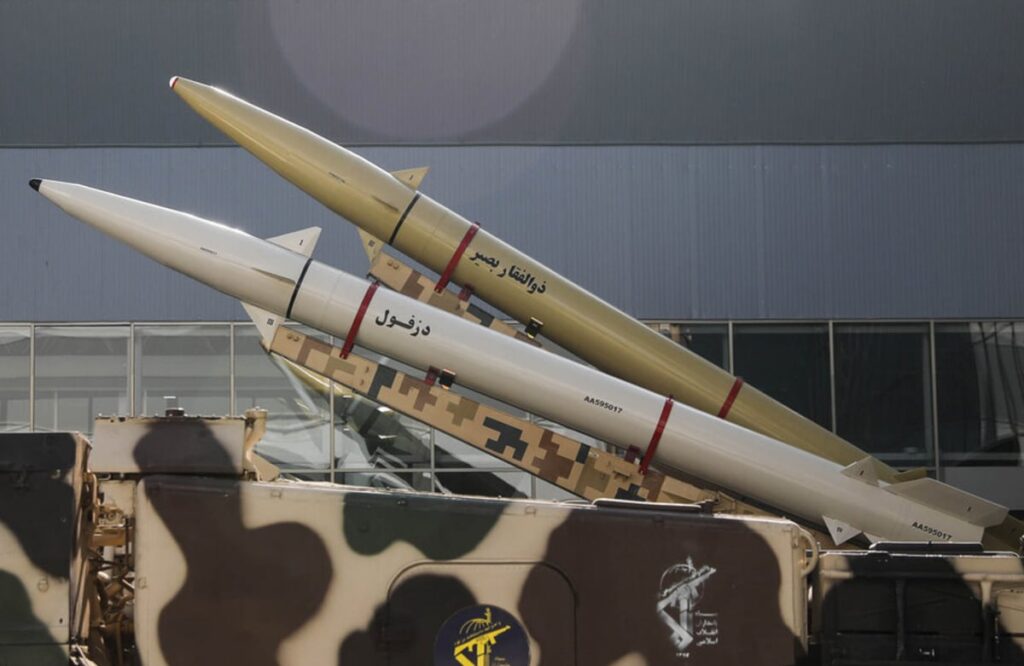
TEHRAN, July 19 — Iran’s ballistic missile and drone arsenal is the largest and most diverse in the Middle East, a capability that shapes the security calculations of countries across Asia and the wider region. The U.S. Defense Intelligence Agency (DIA) assesses that Iran holds an inventory of over 3,000 ballistic missiles, spanning different ranges and purposes.
Among the weapons in Iran’s stable are the Shahab-3, with a range of 1,000 kilometres, and the Emad, which can travel 1,700 kilometres with an accuracy of 10 metres CEP — a figure that points to precision capabilities unusual in the region. The Khorramshahr, with a 2,000-kilometre range, can carry multiple warheads, while the Qiam-1 reaches 750 kilometres and the Fateh-110 about 300 kilometres.
These missiles give Iran the ability to strike targets from neighbouring countries to parts of southern Europe. Iran also fields a substantial drone fleet. The Shahed-136, a one-way attack drone used extensively in Ukraine, the Shahed-131, and the Mohajer-6 are among the unmanned systems Tehran has deployed.
Iran has supplied hundreds of drones to Russia and has used them against both Israeli and U.S. forces in the region.
Domestic Production and Resilience
The Islamic Revolutionary Guard Corps (IRGC) Aerospace Force commander, Hajizadeh, claimed in January 2024 that Iran can produce 150 ballistic missiles per month. While it is difficult to independently verify, the statement highlights the scale of Iran’s manufacturing capacity. Decades of sanctions have forced Iran to develop domestic supply chains for solid propellants, guidance systems, and engines — making its missile production largely independent of foreign components.
This self-reliance complicates efforts to curtail its arsenal through export controls. For communities across Asia, the steady build-up of Iran’s missile stockpile is not a distant concern.
Neighbouring countries face the prospect of being within range, and the proliferation of these weapons to other conflict zones — like the transfer of drones to Russia — further unsettles regional stability.
Recent Use and Defense
On April 13, 2024, Iran launched an unprecedented attack on Israel, firing 110 ballistic missiles, 30 cruise missiles, and 150 drones. According to the Israeli Defense Forces, U.S. and Israeli air defences — including Patriot, THAAD, Iron Dome, and David’s Sling — intercepted 99% of these projectiles. Still, some impacted, demonstrating that even a highly effective defence can be saturated.
In the current campaign, Iran has targeted coalition bases with shorter-range missiles like the Fateh-110 and drones, a tactic that seems calibrated to avoid triggering full-scale retaliation. But the potential for longer-range strikes remains a key element of Iran’s deterrence posture.
Future Developments
Iran is also developing hypersonic glide vehicles. The Fattah, unveiled in June 2023, could complicate existing missile defences if it becomes operational. Hypersonic weapons fly at speeds above Mach 5 and can manoeuvre in flight, making them far harder to intercept than traditional ballistic missiles.
For now, Iran appears to be keeping its most capable systems in reserve. But the combination of a large missile inventory, a growing drone fleet, domestic production independence, and emerging hypersonic technology means that the threat environment for the region — and for Asian neighbours watching closely — is unlikely to ease any time soon.
Sources
{“@context”: “https://schema.org”, “@type”: “NewsArticle”, “headline”: “Iran Expands Ballistic Missile and Drone Arsenal, Boosting Battlefield Impact”, “description”: “TEHRAN, July 19 — Iran’s ballistic missile and drone arsenal is the largest and most diverse in the Middle East, a capability that shapes the…”, “datePublished”: “2026-07-19T09:30:00+00:00”, “author”: {“@type”: “Person”, “name”: “Merry Gel Sigui”}, “publisher”: {“@type”: “Organization”, “name”: “InfoPulse Today”, “url”: “https://newsfeed.infopulsetoday.com/”}, “citation”: [{“@type”: “CreativeWork”, “url”: “https://en.wikipedia.org/wiki/Islamic_Republic_of_Iran_Armed_Forces”}]}




