
From Government Investment to Commercial Dominance
The modern aerospace industrial base did not emerge spontaneously. Military demands during World War I accelerated early aircraft development, while World War II expanded production and introduced jet propulsion. The Cold War’s Space Race in the late 1950s and 1960s pushed the U.S. government to fund rocket science, satellite programs, and human spaceflight—creating the technical and manufacturing foundation that still underpins the sector. NASA’s budget peaked at 4.41% of the total U.S. federal budget in 1966, a level of government spending that helped spur the private-sector companies now predominant in the field. From defense and space contracts, firms such as Boeing, Lockheed Martin, and Northrop Grumman grew into major contractors, establishing a network of manufacturers, suppliers, and launch providers that later branched into commercial markets.
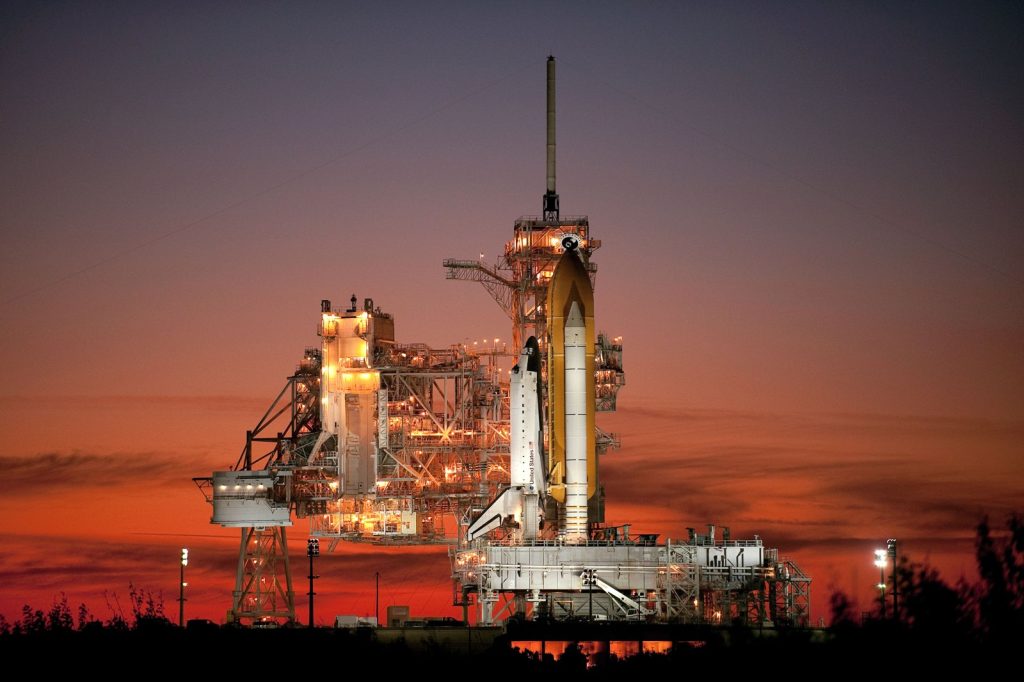
That government-led infrastructure also set the stage for newer entrants. The most prominent among them is SpaceX, founded in 2002. Competition from SpaceX has fundamentally changed the economics of reaching orbit. The company’s Falcon 9 rocket carries a launch cost of about $67 million per mission. For perspective, the Space Shuttle program—a cornerstone of NASA’s human spaceflight efforts—cost roughly $1.5 billion per mission. This dramatic reduction in cost has opened the door to more frequent launches and a host of new commercial applications, from satellite deployment to crew rotations at the International Space Station. The shift toward reusable rockets and smaller satellites has broadened participation, transforming what was once a government-dominated field into a competitive commercial arena.
Cost Reductions Reshape Access to Space
The trajectory of the aerospace industry today relies on continued innovation in launch technology and satellite services. The cost reductions achieved so far have not come at the expense of safety or reliability; strict regulatory standards for safety and performance remain in place across civil aviation, military aviation, and space exploration. The field demands advanced materials, precision engineering, and continuous research, making it one of the most research-intensive sectors in the global economy. These efforts support millions of jobs worldwide, from factory floors to launch sites, and the industry’s products power global communications, transportation, and national security.
The global valuation of $350 billion reflects activity not only in the United States but also across Europe, Asia, and the Middle East. However, the U.S. commercial space sector has been a particular engine of growth, driven by lower launch costs. The current structure is one where government agencies and private companies coexist. NASA still funds research and deep-space missions, while companies like SpaceX handle routine launches to the International Space Station and satellite deployment. Defense contracts, research grants, and public-private partnerships continue to shape the sector. The balance between government spending and private enterprise remains a topic of discussion among policymakers as they consider how to sustain the technological progress and economic activity the aerospace industry generates. Looking ahead, the industry’s future will depend on the pace of innovation in launch technology and satellite services—factors that will affect everything from internet connectivity to national security.




