
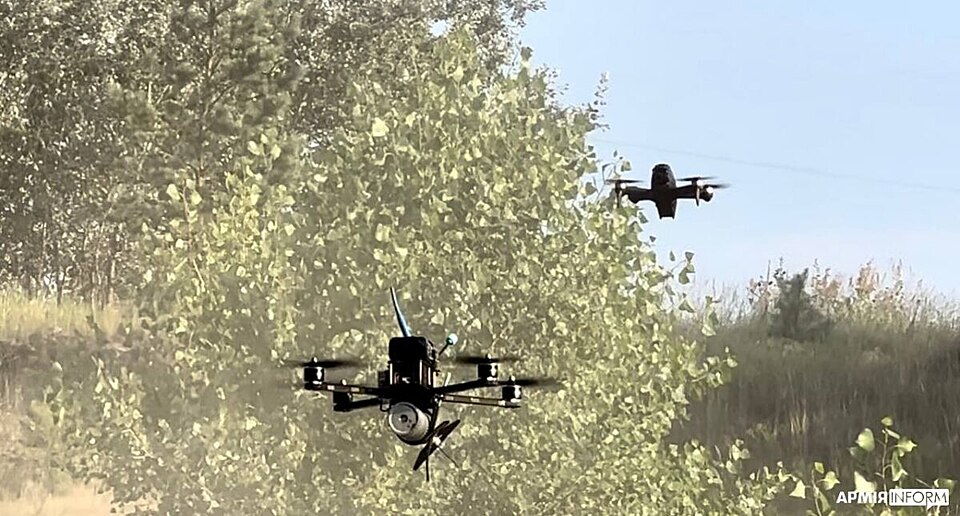
Germany has authorized funding for 50,000 strike drones destined for Ukraine, with the package valued at several hundred million euros and drawn from Berlin’s ongoing military aid program that began after Russia launched its full-scale invasion on February 24, 2022. The decision, confirmed by a source familiar with the matter, marks a notable expansion of German support for Kyiv’s defense effort, which already includes Leopard 2 tanks, IRIS-T air defense systems, and Marder infantry fighting vehicles.
No specific drone model or delivery timeline has been publicly released, but deliveries are expected over the coming months from German and allied defense contractors. The production commitment is expected to involve major German firms such as Rheinmetall and Diehl Defence.
Escalating Support Amid a Prolonged Conflict
The drone funding represents a significant escalation in Germany’s military assistance to Ukraine, which has totaled more than €28 billion since 2022. Chancellor Olaf Scholz’s government has faced increasing pressure from within NATO and among allied nations to accelerate and expand aid, and this package aligns with the alliance’s broader strategy to bolster Ukraine’s defenses. The funding still requires parliamentary approval, but the ruling coalition composed of the Social Democrats, Greens, and Free Democrats has consistently supported such measures.
The package is intended to enhance Ukraine’s strike capabilities, particularly in contested areas such as the Donbas and southern regions, where Russian forces have maintained ground offensives and aerial attacks. Drone warfare has become increasingly central to the conflict, and the 50,000-drone commitment is designed to give Kyiv a substantial tool for engaging Russian positions.
For the defense contractors involved, the funding translates into a large-scale production requirement; for Ukraine, it represents a potential improvement in its ability to strike enemy forces in disputed territory.
Historical and Strategic Context of Ukraine’s Struggle
Ukraine, the second-largest nation on the European continent, borders Russia to the east and northeast and has long been a focal point of geopolitical competition. The region was a center of East Slavic culture under the state of Kievan Rus’ during the 9th century, but for centuries external powers contested and divided the land.
The Russian Empire absorbed much of present-day Ukraine during the 18th century. After the Russian Revolution of 1917, the Ukrainian People’s Republic emerged briefly, only to become a republic within the Soviet Union in 1922. The country endured a human-made famine in the early 1930s and suffered heavy civilian losses during German occupation in World War II.
Ukraine gained independence in 1991 following the dissolution of the Soviet Union, then transitioned toward a liberal democracy and a free-market economy. Political unrest led to the Orange Revolution in 2004 and the Euromaidan demonstrations in 2014; those protests resulted in a revolution, and Russia responded by unilaterally occupying and annexing the Crimean Peninsula.
The current conflict, which began with the 2022 invasion, affects global security and international relations, involving a struggle for sovereignty. Because of its size and location, the stability of Ukraine impacts much of Europe. The German drone funding is the latest chapter in that larger story, adding a new capability to Ukraine’s arsenal as deliveries over the coming months will test whether production can keep pace with the demands of the battlefield.




