
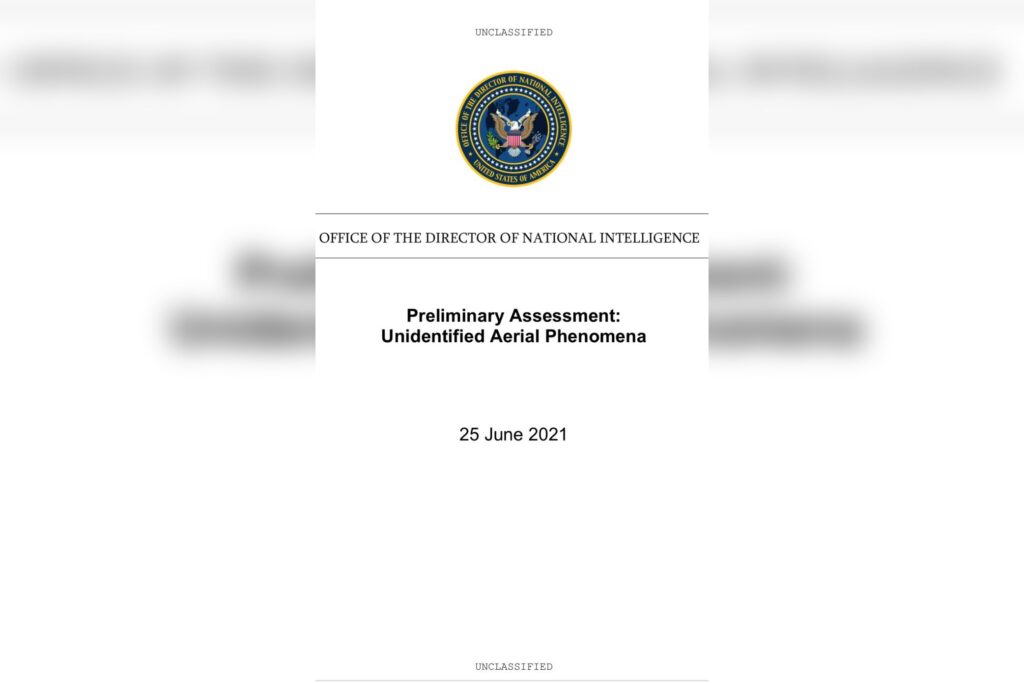
WASHINGTON, July 11 — The Pentagon’s decades-long effort to investigate unidentified aerial phenomena has entered a new chapter of transparency, with declassified documents released in 2024 now providing the most detailed public accounting yet of a government program that has operated in various forms since 1947. The U.S. government’s formal investigation of what are now called unidentified anomalous phenomena began with Project Sign in 1947, followed by Project Grudge in 1949, and the most famous iteration, Project Blue Book, which ran from 1952 to 1969.
Blue Book analyzed 12,618 reports, of which 701 remained unexplained. When the Air Force closed the program, it stated there was no evidence of extraterrestrial threats.
Strategically, the calculus shifted dramatically in 2004 with the USS Nimitz incident, which revived high-level interest within the Pentagon. That event led to the creation of the Advanced Aerospace Threat Identification Program, or AATIP, a secret $22 million program funded from 2007 to 2012 at the request of then-Senator Harry Reid. The program was led by Luis Elizondo and produced reports on materials and propulsion systems.
From Secrecy to Public Accountability
The New York Times revealed AATIP’s existence in 2017, a disclosure that fundamentally changed the public conversation around UAPs. What this signaled was a willingness within the intelligence community to acknowledge that these investigations were not merely historical curiosities but active national security concerns. The Pentagon formally established the Unidentified Aerial Phenomena Task Force in August 2020 under Deputy Secretary of Defense David Norquist.
In November 2021, the Department of Defense created the Airborne Object Identification and Management Synchronization Group, or AOIMSG, to replace the task force. Then in July 2022, under the National Defense Authorization Act for Fiscal Year 2022, the Pentagon established the All-domain Anomaly Resolution Office, known as AARO, directed by Dr. Sean Kirkpatrick.
AARO’s mission includes coordinating across the Pentagon and intelligence agencies, a broader mandate than any previous UAP investigation entity. The broader stakes of this institutional evolution are significant. For over 75 years, the U.S. government has maintained some form of investigation into unidentified aerial phenomena, starting with Project Sign in 1947.
The pattern has been consistent: episodic public interest, periodic official investigations, and a persistent residue of unexplained cases.
The Numbers Tell a Story
AARO’s 2023 annual report covered 291 new reports, with 171 still unexplained. The 2024 AARO report added 118 new cases. These figures represent a substantial increase in reporting volume compared to the Project Blue Book era, when the Air Force analyzed 12,618 reports over 17 years, with 701 remaining unexplained.
The declassified documents released in 2024 are part of AARO’s ongoing transparency efforts. This represents a strategic departure from the secrecy that characterized earlier programs like AATIP, which operated for years without public knowledge.
What this signals to analysts is a deliberate shift in approach. The Pentagon appears to have concluded that managing the public narrative through controlled transparency is preferable to the leaks and revelations that forced earlier disclosures. The 2017 New York Times article on AATIP demonstrated that secrecy could be breached, and the subsequent institutional response has been to build formal mechanisms for public accounting.
The geopolitical chessboard implications are not lost on defense analysts. Adversaries including China and Russia have shown increasing interest in UAP-related technologies and reporting mechanisms.
The U.S. military’s ability to identify and track anomalous objects in sensitive airspace has direct implications for national security, regardless of whether those objects have exotic origins.
Looking Ahead
AARO continues to operate under its mandate to coordinate across the Pentagon and intelligence agencies. The 2024 declassified documents represent a step in what officials describe as an ongoing process of transparency, though the full scope of historical investigations remains classified. The pattern of U.S. government UAP investigations now spans three-quarters of a century, from Project Sign through Project Grudge and Project Blue Book, to AATIP, the UAPTF, AOIMSG, and now AARO.
Each iteration has produced reports, some unexplained cases, and institutional lessons that inform the next phase. For the Pentagon, the calculus is clear: the phenomenon is not going away, and neither is public interest.
The question is whether AARO’s transparency efforts will satisfy congressional oversight and public curiosity, or whether the pattern of periodic revelations and institutional restructuring will continue into the next decade.




