
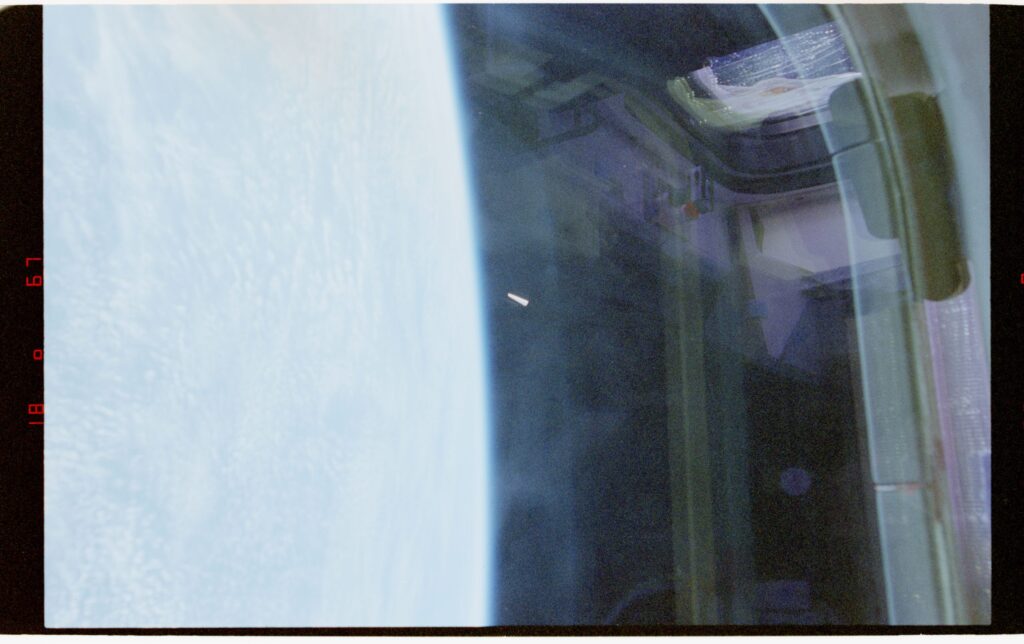
Washington, July 10 — A previously classified image captured by NASA during the STS-80 mission in 1996 has been released this week as part of a broader set of materials from the Pentagon’s UAP investigations. The photograph, designated NASA-UAP-D030, shows an unidentified object in low-Earth orbit as observed by astronauts aboard the Space Shuttle Columbia between November 19 and December 7, 1996. The image, labeled “Unidentified Object Image 1,” depicts the object near the center of the frame, positioned to the right of the Earth’s limb.
No further details about the object’s nature, origin, or implications were provided in the released documentation. This release coincides with heightened global interest in unexplained aerial phenomena, particularly as the Pentagon has intensified its public engagement with UAP-related files.
The STS-80 images were part of a tranche of materials disclosed under the Pursue initiative, which aims to catalog and analyze historical UAP sightings. While the 1996 image predates recent UAP disclosures, its inclusion in the 2026 release suggests a deliberate effort to contextualize decades-old anomalies within modern analytical frameworks. The object’s appearance in a low-Earth orbit photograph raises questions about its classification, though no official explanation has been offered by NASA or the Defense Department. Strategically, the timing of this release may signal a recalibration of how historical UAP data is managed.
By resurfacing the STS-80 images, officials could be attempting to address lingering public skepticism or to preempt future scrutiny. The Columbia mission itself, a routine spaceflight, adds complexity to the narrative.
Astronauts documented the object during a period when space operations were less monitored than today, making the lack of immediate follow-up on the sighting notable. This absence of contemporaneous analysis might reflect either operational priorities at the time or a deliberate decision to suppress the information until now. What this signals is a broader calculus in UAP research.
The Pentagon’s gradual release of older materials aligns with a strategy to build a cohesive dataset, potentially to support policy decisions or technological assessments. However, the lack of technical details in the released image—such as the object’s size, trajectory, or instrumentation—limits immediate interpretation.
Without additional data, experts remain divided on whether the photograph captures a natural phenomenon, a technological artifact, or something beyond current understanding. The absence of named sources or expert commentary in the 2026 release contrasts with previous UAP disclosures, which often included statements from military or scientific personnel. For now, the STS-80 image remains an anomaly within a growing collection of unexplained phenomena.
Its release underscores the challenges of reconciling decades-old data with contemporary investigative standards. While the object’s identity remains unresolved, its presence in a NASA archive highlights the enduring mystery of UAPs.
As the Pursue tranche continues to unfold, attention will likely shift to how such historical records are integrated into ongoing UAP policy discussions. The calculus here is clear: transparency, even partial, may be a strategic move to manage public and political expectations in an era of heightened scrutiny.




