
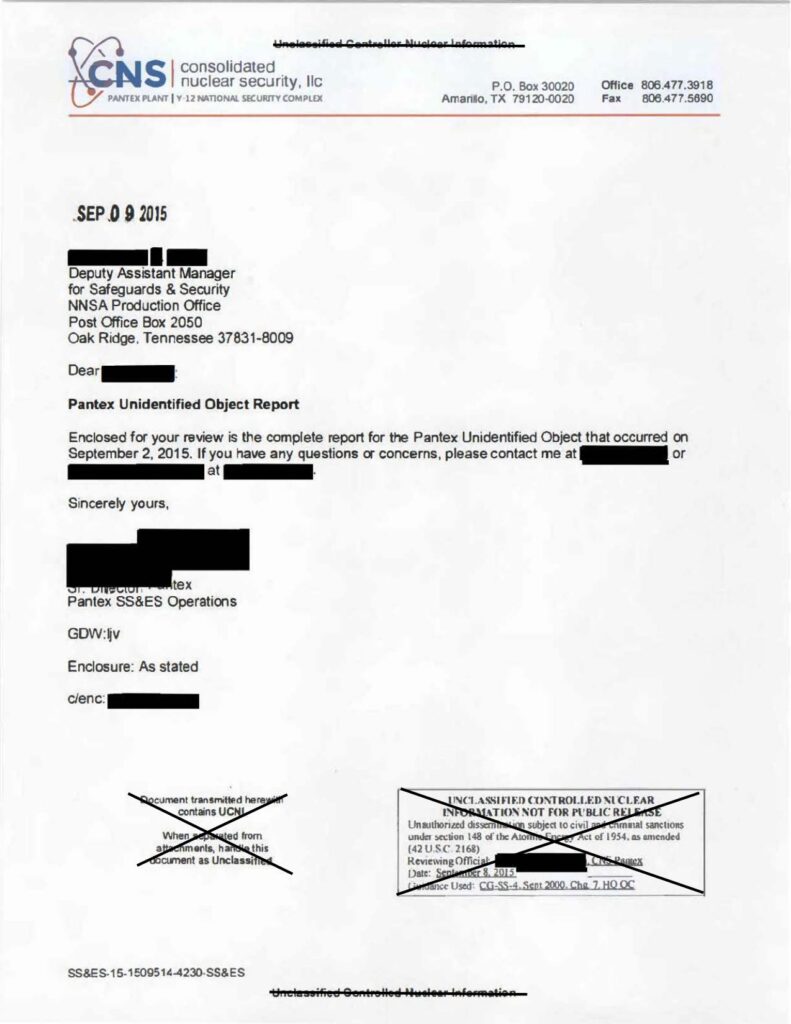
AMARILLO, July 10 — The Department of Energy released a detailed report on July 10 regarding an unidentified object that entered the airspace above the Pantex Plant in Texas on September 2, 2015. The document, classified under DOE-UAP-D005 and part of the PURSUE tranche of disclosures, includes imagery and operational records from the incident. The Pantex Plant, a critical site for nuclear weapons maintenance, remains a high-security location, and the object’s intrusion raises questions about airspace security protocols.
The report confirms the unidentified object was detected during routine surveillance at the plant. Pages 5 and 6 of the file, previously shared in a redacted form on May 22, 2026, under DOE-UAP-D001, provide enhanced imagery that has now been fully disclosed.
The object’s presence was confirmed through sensor data, though its origin, composition, and intent remain undisclosed. The report does not specify the object’s size, shape, or trajectory, leaving key details shrouded in classification. Pantex’s role in nuclear operations amplifies the significance of the incident.
The plant handles the assembly and maintenance of nuclear weapons, making any airborne intrusion a potential threat to sensitive processes. The report notes that security personnel at the time were alerted to the object’s presence, but no immediate action was taken to intercept it.
This has led to speculation about whether the object posed a physical risk or was merely an anomalous occurrence. The DoE has not commented on whether the object was recovered or its current status. The timing of the disclosure underscores the strategic calculus behind declassifying such information. The report’s release in 2026, nearly a decade after the incident, suggests a deliberate effort to address public and congressional interest in unidentified aerial phenomena.
The DoE’s decision to share previously redacted pages indicates a shift in transparency, though the document’s classification level remains Unclassified Controlled Nuclear Information. Analysts note that the timing aligns with broader discussions about national security and the handling of sensitive data.
The broader stakes of this incident extend beyond Pantex. As a facility integral to the U.S. nuclear arsenal, any breach of its airspace could have implications for national defense strategies. The report does not address whether the object was linked to foreign entities or advanced technology, but its presence in a restricted zone highlights vulnerabilities in perimeter security.
With the U.S. facing heightened global tensions, such incidents may influence future policies on surveillance and airspace management around critical infrastructure. The DoE has not released further details beyond what is contained in the document.
The absence of specific figures—such as the object’s altitude, speed, or duration of flight—reflects the limitations of the available data. Without additional context, the incident remains a case study in how sensitive sites balance security with transparency. For now, the Pantex Unidentified Object Incident serves as a reminder of the complexities inherent in protecting national assets in an era of evolving technological and geopolitical challenges.




