
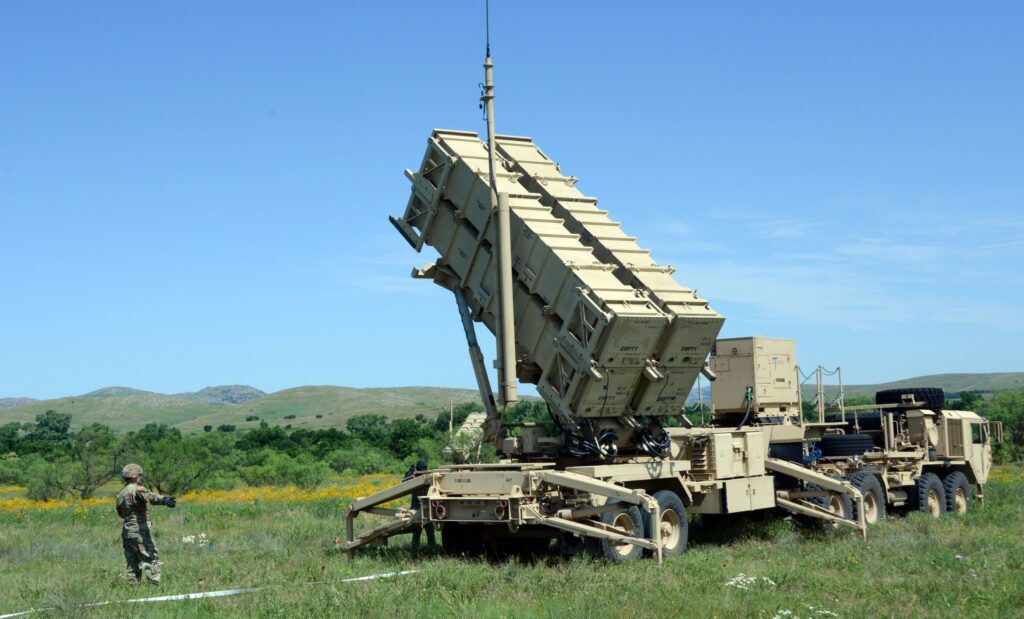
Ukraine’s ambition to produce the Patriot missile system on its own soil has shifted from an abstract goal to a formal planning effort, marking a potential strategic turning point in the country’s long-term air defense posture. The Patriot, a mobile surface-to-air missile system that entered U.S. Army service in 1984, is among the most advanced air defense platforms in the Western arsenal, capable of intercepting both aircraft and ballistic missiles at long range and high altitude.
For Ukraine, which has relied on supplies from Washington to counter Russian airstrikes, the system has become a symbol of dependence on foreign military aid. Each launcher and interceptor delivered from the United States represents not only a military asset but a political decision, with supply lines that stretch across the Atlantic. Establishing indigenous production would mark a strategic shift, reducing reliance on external stockpiles and strengthening Ukraine’s ability to defend its skies over the long term.
The Path to Domestic Production
Moving from battlefield need to assembly line, however, is a process measured in years, not months. The prerequisites for domestic production of the Patriot system are extensive. Technology transfer agreements must be negotiated and signed.
Facilities must be built or retrofitted to handle advanced manufacturing. A supply chain for components and raw materials needs to be established, and an entirely new workforce must be trained to operate complex production machinery.
Before any work can begin, the U.S. Department of Defense must approve both a Technical Assistance Agreement and a Manufacturing License Agreement, a dual-approval process that governs the sharing of sensitive defense technology. There is precedent for such co-production, though the timeline it offers is sobering. Japan began a program to manufacture the PAC-3 variant of the Patriot system in 2015, and it took between three and five years for the country to reach full production output. That example underscores the gap between initial planning and operational manufacturing.
Ukraine’s Industrial Base and the Funding Equation
Ukraine’s defense industry, anchored by the state-owned conglomerate Ukroboronprom, possesses deep experience in producing and maintaining Soviet-era systems. But it lacks the infrastructure required for advanced Western platforms like the Patriot. Oleksandr Kamyshin, Ukraine’s Minister of Strategic Industries, has publicly stated the goal of producing all types of ammunition domestically by 2025.
That ambition, however, does not yet encompass a system as complex as the Patriot. The timeline for any such production remains uncertain but is likely years away given the weapon’s sheer technical sophistication.
In Washington, the financial side of the equation introduces another layer of uncertainty. U.S. funding for a Patriot co-production program in Ukraine would require Congressional approval. The next budget cycle begins in October 2025, meaning that even if political will aligns swiftly, the earliest tranche of dedicated money would not be available until late next year.
What Is at Stake
The stakes are nothing less than Ukraine’s long-term ability to defend its own airspace without depending entirely on finite stocks of foreign-supplied interceptors. The Patriot missile system originated in the 1970s as a U.S. Army program to replace older air defense platforms, evolving from earlier missile projects led by Raytheon. It was officially renamed the Patriot system in 1976 and entered service in 1984, becoming the primary high-to-medium air defense system for the United States and its allies.
Its combat record spans decades, with mixed results in early conflicts but proven effectiveness in later engagements, including against drones and ballistic missiles. Ukraine is pushing to expand its domestic defense industrial base, and the logic of producing its own advanced interceptors is difficult to argue against.
But the gap between aspiration and assembly line remains wide, and the war does not pause for industrial policy. Every step toward self-sufficiency in air defense is an incremental shift in a broader strategic realignment, yet the road ahead demands patience, resources, and sustained political commitment on both sides of the Atlantic.




