
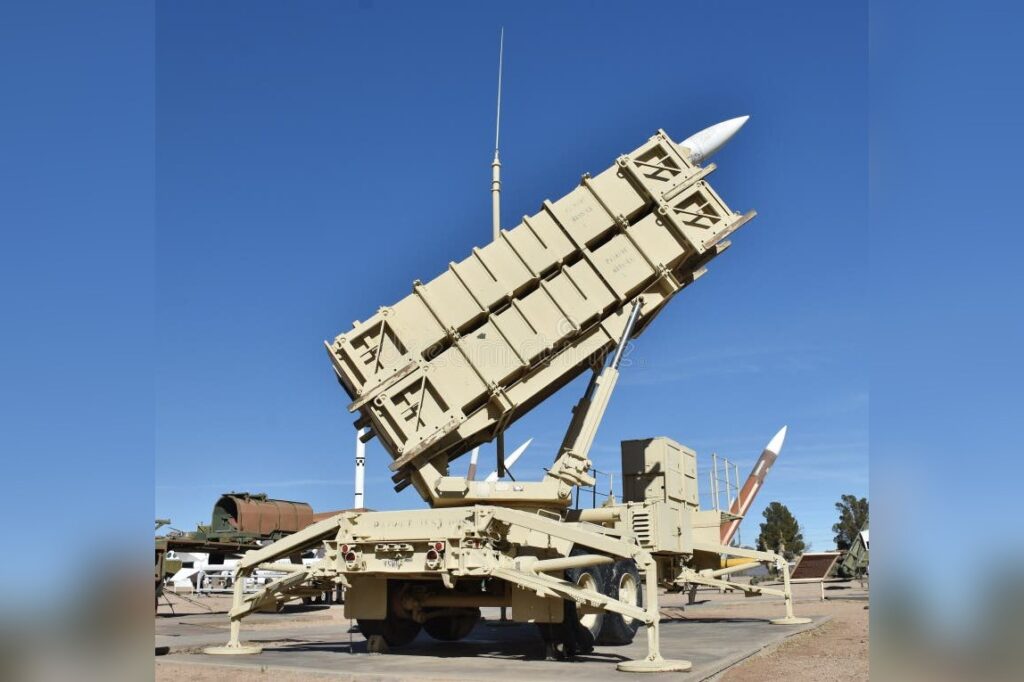
TEL AVIV, July 8 — The MIM-104 Patriot system, built by Raytheon and fielded since 1981, is now in its fifth decade of service. The mechanics here are worth unpacking, because the system’s journey from Cold War air-defense platform to the centerpiece of Ukraine’s missile shield tells a story about military adaptation, cost, and the limits of technology in modern conflict. The Patriot entered U.S. Army service in 1981, designed originally to counter high-altitude aircraft.
Only later was it adapted for the anti-ballistic missile role that defines its current reputation. That first combat test came in 1991, during the Gulf War, when Patriot batteries attempted to intercept Iraqi Scud missiles.
The initial claims of success were dramatic. On closer reading of later analysis, the effectiveness was mixed — a reality that has shadowed the system’s public image ever since. The catch is that the system has been continuously upgraded.
The most significant leap came in the early 2000s with the Patriot Advanced Capability-3, or PAC-3, which uses hit-to-kill technology. That means the interceptor destroys the incoming missile by colliding with it directly, rather than exploding nearby.
It is a more precise, more demanding approach, and it is the version now deployed in Ukraine. Follow the money, and the numbers are stark. Each Patriot battery costs approximately $1 billion, a figure that includes the missiles and training.
That price tag limits how many systems any country can field, and it has shaped the export market. Over a dozen nations have bought Patriots, including Germany, Israel, Japan, and Saudi Arabia. Each of those buyers made a strategic calculation about the value of layered air defense against the system’s enormous cost.
Ukraine became the most recent operator in April 2023, when the first battery arrived after months of training at Fort Sill, Oklahoma. The training pipeline was compressed, but the stakes were existential.
As of late 2024, Ukraine operates multiple batteries, and the reported interceptions include Russian Kh-47 Kinzhal hypersonic missiles. The Kinzhal is one of Moscow’s most advanced weapons, and claims of its defeat by a decades-old system design have been a major propaganda win for Kyiv. But the numbers game is unforgiving.
A single Patriot battery, no matter how advanced, can only cover so much territory. The system’s radar has range limitations, and the interceptor missiles are finite and expensive.
Russia has adapted its tactics, launching salvos to saturate defenses. The math of missile defense has always favored the attacker, who can fire cheaper munitions to exhaust a defender’s stock of million-dollar interceptors. The system’s export history reveals another layer.
Germany bought Patriots, Israel, Japan and Saudi Arabia later. Each sale came with political conditions and technology-transfer restrictions. The U.S. has never sold the most advanced variants to every buyer, maintaining a tiered approach that keeps certain capabilities exclusive to American forces.
Ukraine’s batteries are a notable exception, reflecting the urgency of the conflict. The Patriot’s performance in Ukraine is not the first time the system has faced hypersonic threats, but it is the most publicized.
The Kh-47 Kinzhal is an air-launched ballistic missile that Russia has touted as nearly unstoppable. If the Ukrainian claims of interceptions hold up under independent analysis, it would represent a significant validation of the PAC-3’s hit-to-kill technology. If they do not, the narrative could shift again, as it did after the Gulf War.
What to watch next: the sustainability question. The U.S. and its allies have committed to supplying Ukraine with additional batteries and interceptors, but production rates at Raytheon’s facilities are not infinite.
The Army has its own stockpile requirements, and other allied nations have their own defense needs. The tension between domestic readiness and foreign military aid is not new, but the Patriot’s $1 billion-per-battery price tag makes every transfer a significant political and financial decision. The system’s longevity is a testament to its upgrade path, but also to the slow pace of replacement programs.
The U.S. Army is developing new air and missile defense systems, but none have yet reached full operational capability. Until they do, the Patriot remains the backbone of American and allied theater missile defense. That means the next few years will test whether a 1980s architecture, however upgraded, can keep pace with 2020s threats.
For now, the Patriot is the shield Ukraine has, and the one Russia is trying hardest to defeat. The outcome of that contest will inform defense procurement decisions in Washington, Berlin, Tokyo, and Riyadh for a generation.




