
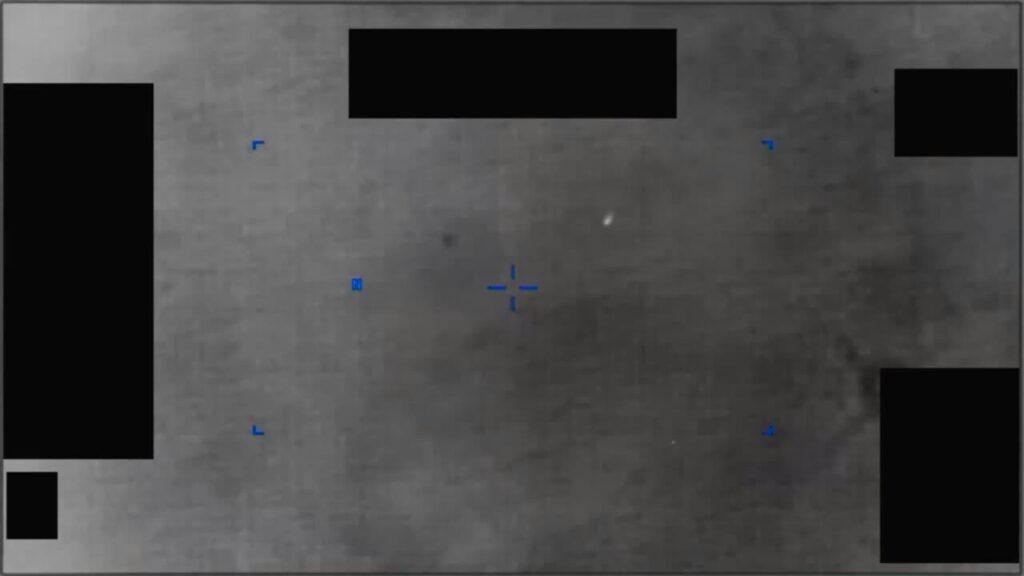
The Department of War has made public a classified document that records an unidentified anomalous phenomena (UAP) sighting that took place in Syrian airspace on 31 August 2022. The report, labeled PR89, was released under the Pentagon’s PURSUE policy, a framework intended to broaden openness about UAP events while safeguarding sensitive collection methods and sources. Processing of the file was handled by the All‑domain Anomaly Resolution Office (AARO), which operates within the Office of the Secretary of Defense.
According to PR89, a U.S. military aircraft conducting operations over Syria detected an unknown object whose flight behavior did not match any known aircraft or natural atmospheric occurrence. The platform’s suite of sensors—combining radar with electro‑optical/infrared (EO/IR) systems—tracked the object for roughly twelve minutes before it accelerated away at high speed.
The report does not name the specific aircraft or the exact sensor configuration, but it notes that two separate aircraft sharing the same callsign were involved in the observation, as indicated by the filename “dow‑uap‑pr089‑31‑aug‑callsign‑callsign‑observes‑uap‑part2.” The “part 2” designation suggests this segment follows an earlier, still‑classified portion of the investigation. Technical analysis within the document describes the object as lacking any visible propulsion mechanism or aerodynamic control surfaces. Its maneuvers generated g‑forces that would exceed the tolerance limits of human pilots, and its estimated departure speed reached Mach 2.5.
No electronic emissions were recorded from the phenomenon, eliminating possibilities such as conventional electronic‑warfare platforms or known drone signatures. AARO analysts, after reviewing the collected data, classified the encounter as “unresolved.” The designation means that the object could not be identified as any known U.S., allied, or adversary technology.
The report deliberately refrains from speculation about the object’s origin or nature. The declassification aligns with ongoing congressional directives demanding greater transparency on UAP matters. Under PURSUE, AARO is obligated to release reports that do not jeopardize national security, and this file was selected for early release because of the high‑quality sensor recordings and the unusual flight characteristics displayed by the object.
Future actions outlined by AARO include soliciting additional information from the units that participated in the original observation. Requested material may encompass maintenance logs, crew debriefs, and any supplemental sensor data that were not part of the initial packet.
The office also retains authority to direct intelligence‑collection assets to search for similar phenomena in the region and to cross‑reference the flight path with other contemporaneous sensor records. The release of PR89 represents a step in the Pentagon’s broader effort to document and analyze UAP incidents while balancing the need for secrecy in operational matters. As AARO continues its review, further updates may emerge if new data clarifies the nature of the unidentified object observed over Syria in August 2022.




