
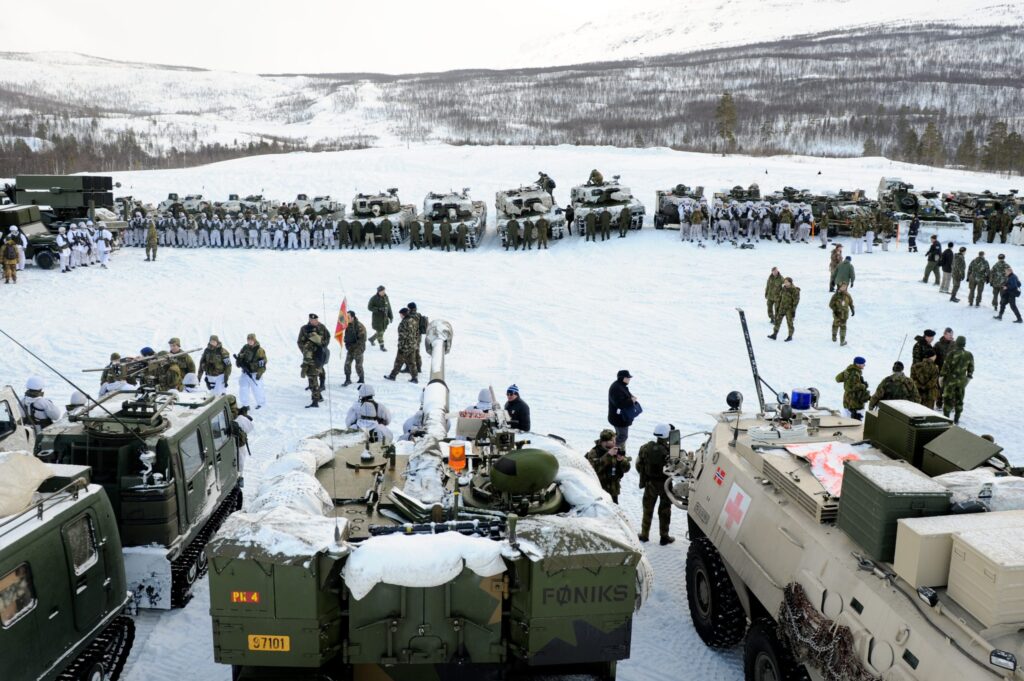
The conclusion of the “Cold Response” military exercises on March 23 in the Norwegian Arctic has highlighted a fundamental change in how NATO views Russian aggression. Speaking from the Bardufoss airbase, Gen. David Berger, Commandant of the U.S. Marine Corps, warned that the invasion of Ukraine on February 24 has invalidated previous assumptions regarding Vladimir Putin’s risk tolerance.
Berger noted that while NATO understands Russian doctrine and capabilities, the decision-making of a dictator remains unpredictable, requiring the alliance to prepare for an adversary willing to take greater risks. The biennial drill involved approximately 30,000 personnel from 27 different nations, including 3,000 U.S. Marines. Operating less than 300 km from the Russian border, forces practiced cold-weather logistics, air-defense maneuvers, and amphibious landings.
These activities included British Apache helicopters practicing tank kills and U.S. hovercraft deploying Marines onto icy shores. Logistics officers focused on critical winter survival skills, such as preventing engines from freezing and transporting fuel through avalanche zones and fjords.
Western intelligence officers admitted that previous models based on Russia’s 2015 actions in Syria and the 2014 annexation of Crimea are now useless. Rather than limited incursions, Putin has employed nationwide mobilization, city sieges, and high-alert nuclear forces, while accepting severe sanctions on the rouble. This shift has forced NATO planners to consider diverse threats, ranging from cyberattacks on under-sea cables—which carry 95 percent of global data traffic—to the potential use of tactical nuclear weapons.
The exercises, which simulate a response to an attack on Norway under Article 5, felt particularly urgent this year. Norwegian soldiers expressed a sharpened resolve; Private Leo Ryan stated that Ukraine’s resistance provided courage to fight, while Private Filip Buyle suggested that the lack of choice for Russian conscripts could give NATO a morale advantage in the High North.
In response to the changing security landscape, diplomats in Brussels have agreed to increase the size and frequency of future drills. Defense ministers are expected to pre-position heavy equipment in the Baltic states, Poland, and Norway, while expanding the rapid-reaction force from 40,000 to 300,000 troops. Norway, which historically avoided permanent foreign bases to avoid provoking Moscow, is now accepting rotational U.S. Marine deployments and the storage of U.S. armor in mountain caves near Trondheim. While there is no evidence of an imminent Russian assault on NATO territory, the proximity of the two forces is significant.
The Russian Northern Fleet is headquartered in Murmansk, and the garrison at Pechenga is only a 15-minute drive from Norway’s Grense Jakobselv checkpoint. Recent Russian activity includes GPS jamming over Tromsø and mock flights against Norwegian radar.
NATO uses these drills to signal strength and collect telemetry on Russian radars that activate during alliance flights. Observations of captured Russian equipment at Bardufoss revealed “brittle” logistics, with a British officer noting the use of cheap Chinese tires and welded-on farm steel for armor. However, the officer cautioned against complacency, noting that the ability to move 150,000 troops into Ukraine suggests a smaller force could be moved into the Arctic under nuclear cover.
As Finland and Sweden accelerate their membership bids, the Arctic may become a primary friction point for the alliance.




