
The Moon, January 1, 1969 — infopulsetoday.com — 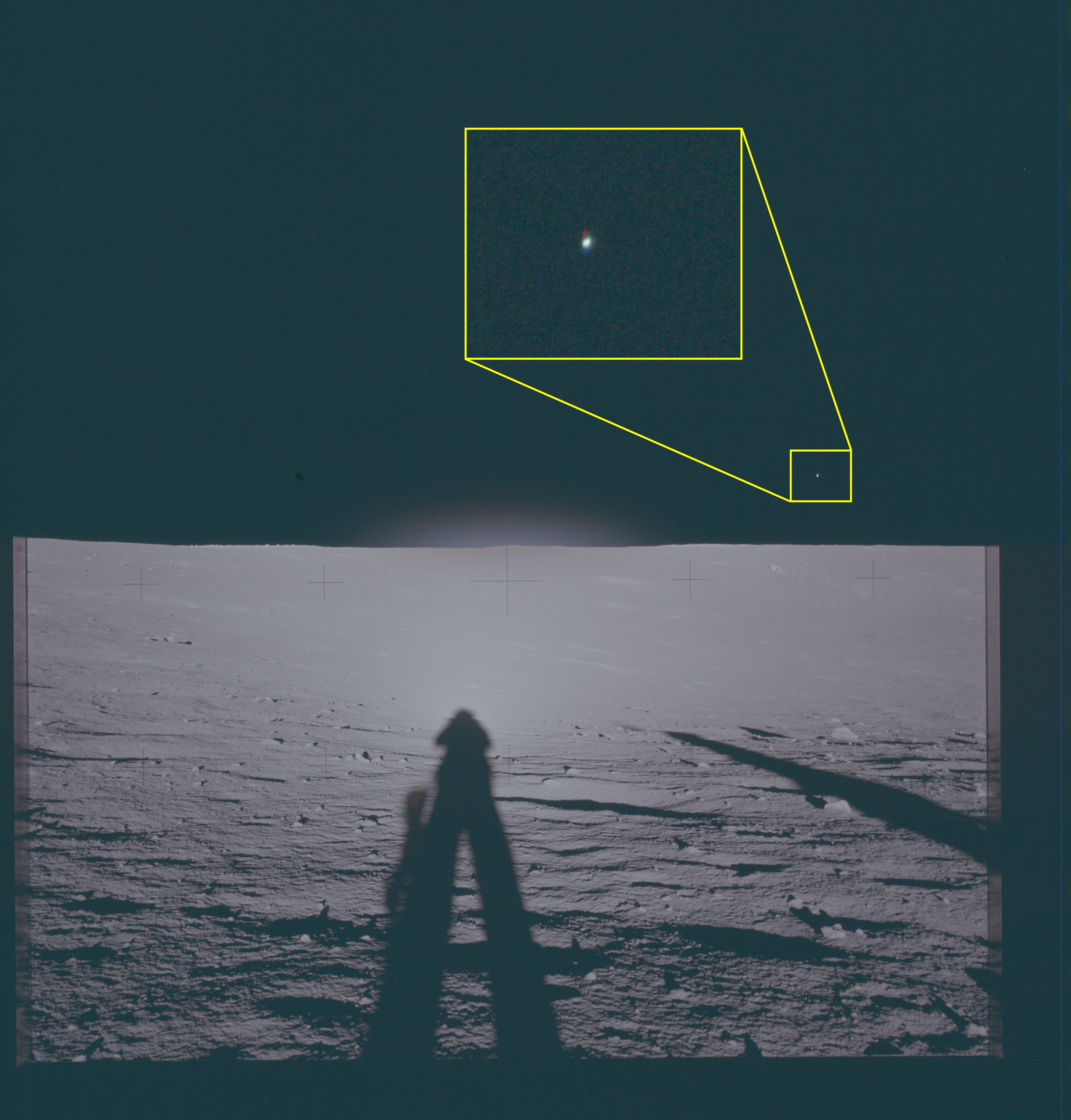 An archival photograph from NASA’s Apollo 12 mission, released by the U.S. Department of War under the PURSUE archive, depicts the lunar surface with a highlighted area of interest near the right edge of the frame, above the horizon, in which unidentified phenomena are visible.
According to the NASA document, titled “NASA-UAP-VM3, Apollo 12, 1969,” and released on May 8, 2026, the image has been modified from its original state to assist viewers in identifying specific areas of interest. The official description states that these highlights are provided for contextual purposes only and do not constitute an analytical judgment, investigative conclusion, or factual determination regarding the nature or significance of the subject matter.
What the Document Shows
The record, available as a PDF at the war.gov domain, lists the incident date as 1969 and the incident location as the Moon. The original photograph, as described in the official summary, shows the lunar surface as viewed from the landing site of Apollo 12.
The highlighted area of interest appears above the horizon and contains what the document terms “unidentified phenomena.” The record’s official summary offers limited detail beyond this, noting that the modifications are intended for contextual identification only and that no analytical judgment or factual determination has been made about the nature or significance of the subject matter. The document is part of the PURSUE archive, a government repository managed by the U.S. Department of War.
The release date of May 8, 2026, indicates that this is a recent disclosure of historical material. The NASA document itself does not provide additional commentary, witness accounts, or technical analysis beyond the brief description. It is presented as an archival photograph with a highlighted region, leaving the interpretation of the phenomena to the viewer.
Context from NASA’s UAP Study Team
Per a Wikipedia summary of the NASA Unidentified Anomalous Phenomena Independent Study Team (UAPIST), this panel of sixteen experts was assembled in 2022 by NASA and chaired by David Spergel. The team’s purpose was to recommend a roadmap for the analysis of unidentified anomalous phenomena (UAPs) by NASA and other organizations. Wikipedia’s entry on the topic notes that the study team was established to provide a structured approach to examining UAPs, which are defined as objects or events in the air, sea, or space that are not immediately identifiable.
The existence of the UAPIST provides institutional context for the release of the Apollo 12 photograph under the PURSUE archive. While the document itself predates the study team by over five decades, its release aligns with broader government efforts to make historical UAP-related records accessible.
The Wikipedia entry does not directly reference the Apollo 12 image or any specific findings from the study team, but it establishes that NASA has formally engaged in the analysis of UAPs since 2022. The team’s work, as summarized by Wikipedia, focuses on developing methodologies for data collection and analysis, rather than on individual cases like the Apollo 12 photograph.
The record’s release under the PURSUE archive suggests that the government considers this material relevant to ongoing UAP investigations, though the official description explicitly cautions against drawing conclusions from the highlighted areas. The document does not provide any identification of the phenomena, nor does it offer a hypothesis about their origin.
The record’s summary is limited to stating that the highlighted area contains “unidentified phenomena,” without further elaboration on shape, movement, or other characteristics.
What Remains Unanswered
The Apollo 12 photograph raises several questions that are not addressed by the available documentation. The official description does not specify what the highlighted phenomena are, how many there are, or why they were considered noteworthy enough to be included in the PURSUE archive. The record does not provide any corroborating data, such as telemetry from the Apollo 12 mission, astronaut testimony, or subsequent analysis by NASA or other agencies.
The document’s emphasis that the highlights are for contextual purposes only leaves open the possibility that the phenomena could be artifacts of the imaging process, natural lunar features, or something else entirely. Readers should watch for future PURSUE releases that may provide additional context for this image or similar records from the Apollo program.
The PURSUE archive, as a government repository, may release further documents that include analysis, additional photographs, or other data that could clarify the nature of the phenomena shown in this image. Without such supplementary material, the Apollo 12 photograph remains an intriguing but unexplained archival record. The NASA document itself does not resolve the question of what the highlighted phenomena are, and the official description deliberately refrains from making any analytical judgment.
As the PURSUE archive continues to release historical records, future disclosures may shed light on this and other cases from the early space program.




