Human-in-the-Loop for the High-Stakes Game of Missile Defense
Aptima, a small firm on the Missile Defense Agency’s $151 billion SHIELD contract, is proposing to apply artificial intelligence not to build interceptors, but to assist human operators in making the time-sensitive decisions required by the Golden Dome missile defense architecture. The technical reality of this approach, as ever, is in the detail that matters: Aptima is focused on human-machine teaming, designing systems to assist people rather than replace them.
The question of how an AI decision support system like Aptima’s could connect to a system of space-based interceptors gets to the core of the Golden Dome’s operational challenge. The program, directed by Space Force Gen. Michael Guetlein, is intended to integrate existing and future defenses against ballistic, hypersonic, cruise missile and other aerial threats. The technical architecture is not a single entity but a layered one. The problem, as defined by the program’s leadership, is not simply developing individual weapons or sensors, but connecting those systems into a coherent architecture that can respond quickly enough to be effective. This is where the human operator remains central, and where Aptima’s proposed AI enters the picture.
Under the hood of this proposed system, the AI would not be making the final launch decision. Instead, it would process the vast amount of data from a network of sensors, including those that might cue a space-based interceptor. The AI’s role would be to present a synthesized, high-fidelity picture of the threat to the human operator, highlighting the most relevant data points and potential courses of action. The human operator, retaining ultimate oversight, would then use this enhanced situational awareness to make the final call. This ‘human-centered engineering’ approach, as Aptima’s division director for Performance Augmentation Systems, Sylvain Bruni, describes it, puts the human at the center of the technology, whether that involves training, readiness, modeling and simulation, or decision support.
The $151 billion SHIELD contract, of which Aptima is one of more than 2,400 eligible holders, provides the potential vehicle for this work. It is a multiple-award indefinite-delivery, indefinite-quantity contract structured to allow the Missile Defense Agency to rapidly compete for orders covering research and development, including AI, machine learning, and digital engineering. The SHIELD framework is designed to be flexible, enabling the rapid integration of new technologies like Aptima’s into the broader Golden Dome ecosystem without requiring a complete overhaul of the system’s architecture. The connection is therefore not a direct physical one, but an informational one, where the AI acts as a powerful cognitive tool for the human operator who is ultimately responsible for the system.
The significance of this approach is underscored by the program’s current funding precariousness. The White House has requested $5 billion in anomalies for Golden Dome in the next continuing resolution, stating the program “has no new funding under the current CR” and will be unable to continue production without it. This funding gap highlights the pressure on the system to perform efficiently. An AI that can help operators make faster, more informed decisions could be a critical force multiplier, allowing the existing and future layers of the Golden Dome, including any space-based components, to function as an effective integrated defense. The technical architecture, therefore, is one of human and machine working in concert, a necessity for a program whose future funding remains uncertain.
Sources
- Golden Dome's 'Secret Sauce' Isn't a Missile. This Small Defense Firm Wants to Help Humans Make the Call
- White House seeks funding exemptions for Golden Dome, Trump battleship in next funding stopgap – Breaking Defense
- White House Seeks Exceptions to Fund Golden Dome, MQ-9
- Golden Dome, Munitions Funding Protections Needed: White House | Aviation Week
- Trump is one step closer to his ‘Golden Dome’ in Greenland, and it will be ‘absolutely devastating’ for U.S.-European relations | Fortune
- Senate Decreases Potential Golden Dome Funding – Association of Defense Communities (ADC)
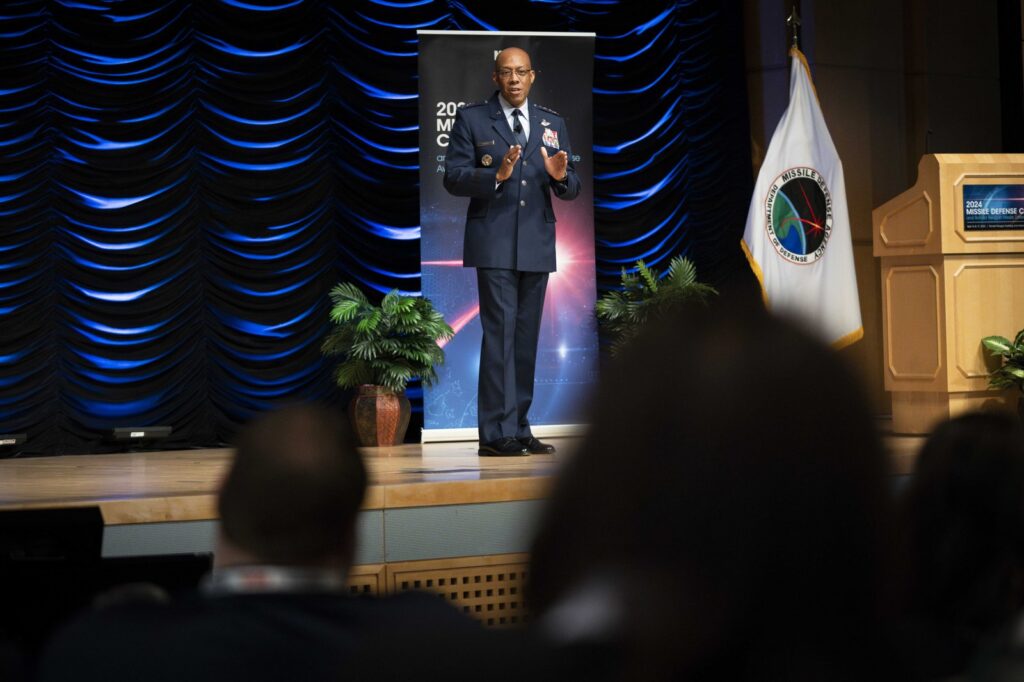
Photo: Chairman of the Joint Chiefs of Staff (CC BY 2.0)