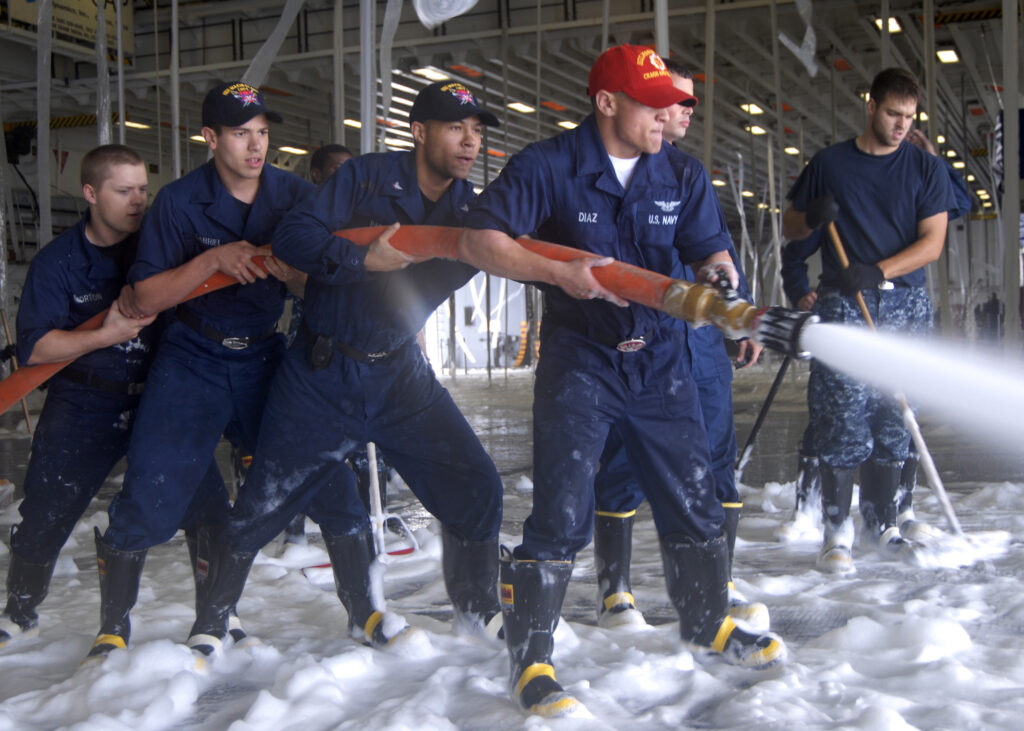
For decades, the firefighting foam that protected flightlines, hangars and ships also carried a hidden cost. Aqueous film-forming foam — known as AFFF — smothered jet-fuel fires faster than anything else available, so the military made it standard from the 1960s onward. It also contains PFAS, the “forever chemicals” now linked to several cancers. Today that legacy has become one of the largest bodies of litigation in the country, and military veterans and firefighters sit at the center of it.
Why veterans are the hardest hit
PFAS compounds such as PFOA and PFOS do not break down in the environment or the body. They accumulate over years and have been associated in scientific studies with kidney cancer, testicular cancer, thyroid disease and ulcerative colitis, among other conditions. Military firefighters, aircraft crews and personnel who trained with AFFF sprayed it repeatedly and directly. Many others simply lived and worked on bases where the foam seeped into the groundwater they drank. That combination — heavy direct use plus contaminated base water — makes the veteran community one of the most exposed populations in the nation.
Where the lawsuits stand
Every federal AFFF case has been gathered into a single proceeding: In re: Aqueous Film-Forming Foams Products Liability Litigation, Multidistrict Litigation No. 2873, before Judge Richard Gergel in the U.S. District Court for the District of South Carolina. It moves on two separate tracks.
The first is a water-provider track, in which cities and utilities sued the manufacturers over contaminated public drinking water. That track has already produced enormous settlements. In 2023, 3M agreed to pay public water suppliers up to $10.3 billion over 13 years, and DuPont, Chemours and Corteva together agreed to roughly $1.18 billion. It is important to understand what those figures are: money for water systems to clean up supplies. They are not payments to individual veterans.
The second track is for personal injury — individual people who developed a qualifying illness after exposure. That track is still building. As of September 2026 more than 15,000 personal-injury claims were pending, roughly double the number a year earlier. A kidney-cancer test trial that had been set for October 2025 was taken off the calendar and has not yet been reset, and the court is now assembling a second group of representative cases to try. As of this writing, no personal-injury trial has been decided and no personal-injury settlement has been announced. Attorneys have projected individual awards ranging from about $200,000 to $1 million or more depending on the severity of illness, but those are estimates, not court-ordered amounts.
Who may be able to file
A personal-injury AFFF claim generally rests on two things: documented exposure and a qualifying diagnosis. Exposure can mean direct use of the foam as a military or civilian firefighter, work or residence near a contaminated site such as a base or airport, or drinking PFAS-contaminated water. The core qualifying conditions are kidney cancer, testicular cancer, thyroid disease and ulcerative colitis. Claims are filed through a plaintiffs’ attorney into MDL 2873.
One point deserves emphasis, because it confuses many veterans: an AFFF lawsuit is a product-liability case against the chemical manufacturers. It is separate from the VA. Winning or joining the lawsuit is not a VA benefit, and filing a VA disability claim is a different process with different rules. The two can run in parallel — the same exposure may support both — but they are not the same thing.
How to file a claim
There is no government sign-up form for an AFFF lawsuit the way there is for a VA claim — and that difference matters. A personal-injury AFFF claim is filed by an attorney into MDL 2873 on your behalf. The practical first step is a free case review with a law firm that handles AFFF or PFAS cases.
They will look at your exposure history and your diagnosis, tell you whether you likely qualify, and, if so, file the claim. Be ready to provide two things: proof of exposure (military service and assignment records, an occupation as a firefighter, or documentation of contaminated water where you lived or worked) and medical records showing a qualifying diagnosis — kidney cancer, testicular cancer, thyroid disease or ulcerative colitis.
What the costs look like
These cases are almost always handled on a contingency basis. That means no money out of pocket to start: the attorney is paid only if you recover, taking a percentage of the award — commonly around one-third to 40 percent — plus case costs deducted from the recovery. The initial consultation is free. One rule protects you from the scams that follow every mass tort: never pay an upfront “registration” or “sign-up” fee to join a lawsuit. Legitimate firms do not charge you to file.
What to expect from a settlement
Be realistic about both amount and timing. As of late 2026 there is no personal-injury settlement in the AFFF litigation, and no individual case has gone to a verdict. A broad resolution is widely expected in 2026 or 2027.
Attorneys have projected individual awards ranging from roughly $200,000 to $1 million or more, driven mainly by the severity of the illness and the strength of the exposure evidence — but those are projections, not promises, and nothing is paid until there is a settlement or a verdict. Remember that the large 3M and DuPont settlements were paid to public water systems, not to individual claimants. Deadlines also matter: the filing window (the statute of limitations) varies by state and by when the illness was diagnosed, so waiting can cost a valid claim.
If an ad promises a specific dollar figure or pressures you to act instantly, treat it as a warning sign, and for any parallel VA benefit work with an accredited Veterans Service Officer, whose help is free.
How to find a reputable lawyer
Because these claims are filed through an attorney, choosing the right one matters. A few practical checks go a long way. Confirm the lawyer is licensed and in good standing through your state bar’s website, which also lists any disciplinary history.
Favor firms with real experience in the AFFF litigation or in large multidistrict “mass tort” cases, rather than a general practice picking up a new area. Ask directly whether the firm files its own cases into MDL 2873 or simply refers them to another firm for a share of the fee — referrals are legal, but you deserve to know who will actually handle your case. Get the fee agreement in writing, including the contingency percentage and how case costs are treated.
Ask for a clear point of contact. And be wary of any operation that reaches you through a robocall, a mass text or a website that asks you to “register” and pay a fee. Reputable firms give a free consultation and never charge to sign up; the first call should feel like an evaluation of your case, not a hard sell.
Who is leading the litigation
The AFFF cases are run by attorneys the court appointed to lead the consolidated proceeding — a role separate from the individual lawyer a claimant hires. In MDL 2873, the court named three firms as Plaintiffs’ Co-Lead Counsel: Douglas & London, P.C. of New York (Michael A. London); Motley Rice LLC of Mount Pleasant, South Carolina (Joseph F.
Rice); and Baron & Budd, P.C. of Dallas (Scott Summy), with Motley Rice’s Fred Thompson III serving as liaison counsel. Those appointments date to the litigation’s early case-management orders in 2019 and are periodically renewed by the court, and a broader Plaintiffs’ Executive Committee of additional firms works under that leadership. This is noted here as a matter of public court record, not as a recommendation — you are free to hire any qualified attorney you choose.
What this section will do
This is the first in a series here on veteran-support litigation. In the weeks ahead we will map the other major actions — the Camp Lejeune water claims, the 3M combat-earplug settlement, the long shadow of Agent Orange and the burn-pit benefits opened by the PACT Act — and walk through the VA claims process step by step. The goal is simple: put the facts where veterans and their families can find them.
This article is general information, not legal or medical advice. Deadlines and eligibility rules change, and every case is different. Veterans considering an AFFF claim should speak with an accredited Veterans Service Officer or a licensed attorney, and should consult their doctor about any health concern.