British Minister of State Luke Pollard reaffirmed the government’s intention to procure up to 12 SSN-AUKUS nuclear-powered attack submarines on October 12, according to a parliamentary response reported by Army Recognition. The declaration confirms a potential 71.4 percent expansion of the Royal Navy’s planned attack fleet from the current seven Astute-class boats.
Procurement Targets and Fleet Expansion Goals
The Ministry of Defence has committed approximately £4 billion to development contracts and £6 billion to industrial expansion for the programme, according to Army Recognition. Steel cutting for the first British SSN-AUKUS is scheduled for 2027, with operational entry slated for the late 2030s. The eventual objective is to complete one submarine every 18 months, a production rate that would require 16.5 years between the first and twelfth deliveries, placing completion of the proposed fleet in the mid-2050s if the initial submarine enters service on schedule.
Pollard did not disclose whether the government would fund all 12 submarines after the 2027 spending review, or establish a revised procurement schedule before the Detailed Design and Long Lead phase ends in 2028, the record shows. The reaffirmation came in response to Conservative MP Ben Obese-Jecty, who had questioned the fleet’s future after the upcoming spending review. As of September 2026, five Astute-class submarines had entered operational service: HMS Astute, HMS Ambush, HMS Artful, HMS Audacious, and HMS Anson. The sixth, HMS Agamemnon, was commissioned in September 2025 but remained in trials following its first trim dive, while HMS Agincourt was still under construction.
Historical Background: From SSNR to AUKUS Partnership
The United Kingdom began planning for the replacement of the Astute class in early 2018 under the Maritime Underwater Future Capability concept, according to programme history documented on Wikipedia. The concept phase was scheduled to last three years but was suspended for two years due to delays in the Astute-class and Dreadnought-class delivery programmes. In 2020, the Ministry of Defence recruited a Submarine Delivery Agency Project Manager to work on what was then named the Submersible Ship Nuclear Replacement design.
The government’s 2021 defence paper, Defence in a Competitive Age, committed to funding the SSNR project, the record shows. This was followed in September 2021 by an investment of £170 million in the form of two £85 million contracts to BAE Systems and Rolls-Royce Holdings for early design work. In March 2023, the ongoing SSNR design was renamed SSN-AUKUS under the trilateral security partnership, when Australia joined the programme and additional US technology was incorporated into the design. The class will be powered by Rolls-Royce PWR3+ nuclear reactors and displace over 10,000 tonnes, significantly larger than the Astute-class displacement of approximately 7,400 tonnes submerged.
Australia plans to build five SSN-AUKUS submarines in addition to acquiring three nuclear-powered Virginia-class submarines from the United States, according to the same source. When in service with the Royal Navy and the Royal Australian Navy, submarine crews will train and patrol together and undertake joint maintenance and support, with components and parts shared with the US.
Industrial Constraints at Barrow-in-Furness and Raynesway
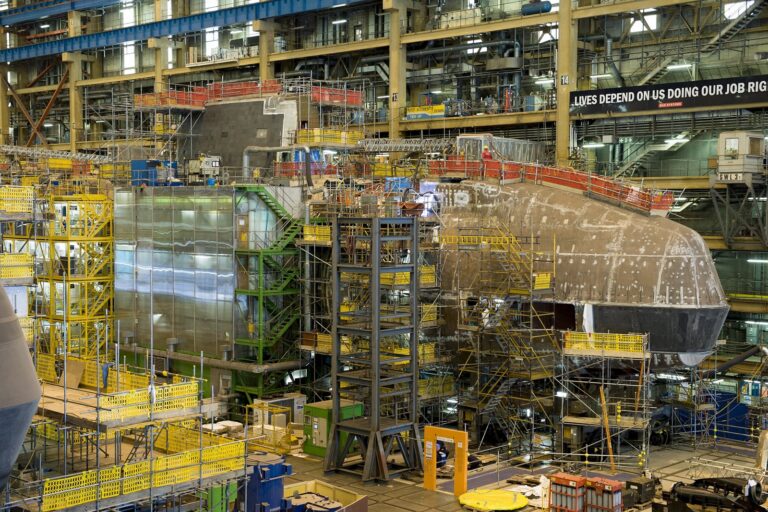
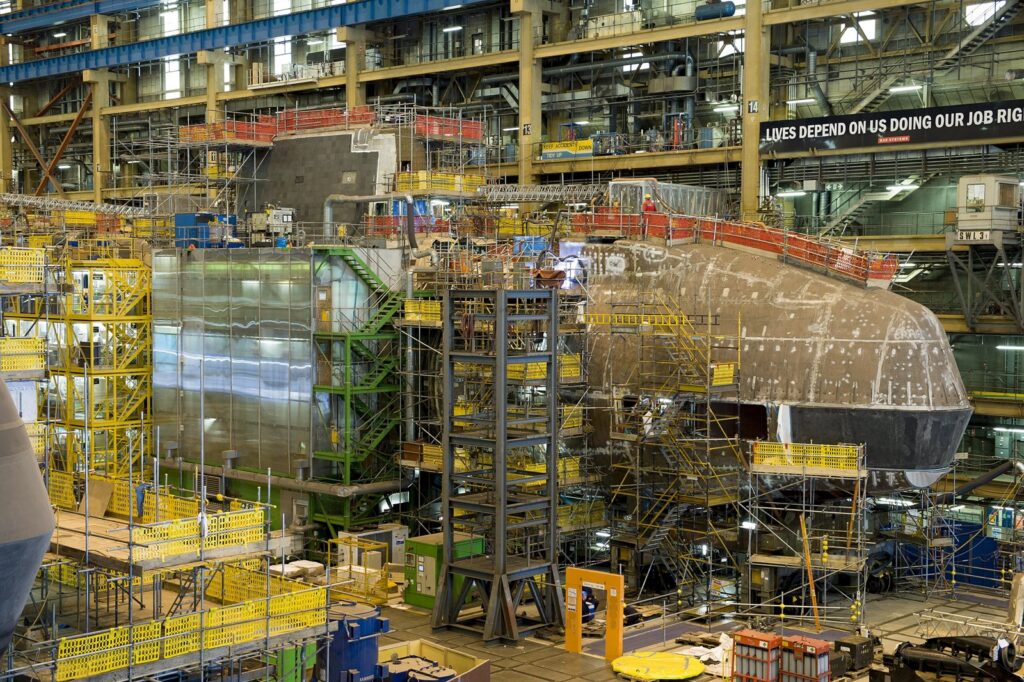
The plan faces critical industrial constraints at BAE Systems’ Barrow-in-Furness shipyard and Rolls-Royce’s Raynesway facility, according to Army Recognition. Only two shipyards in Britain are certified to build nuclear submarines, managing both Astute-class and Vanguard-class fleets, the 19FortyFive analysis notes. A British Parliamentary Defense Committee inquiry found that the sole submarine shipyard at Barrow-in-Furness is over capacity, with Britain’s other two nuclear-powered submarine classes having consumed all the shipyard’s capacity and workers.
This bottleneck has not only affected the British fleet but is also causing serious complications for Australia, the 19FortyFive report states. The Royal Navy now has to fulfill its early AUKUS agreements by deploying whatever submarine it has available, such as HMS Anson, one of the few Astute-class submarines available at the time, to Western Australia. While there, the Anson conducted the first-ever joint nuclear submarine operations with Australian forces, demonstrating the operational imperative driving the partnership despite industrial limitations.
Production Timeline and Funding Uncertainties
The 18-month delivery objective represents an ambitious cadence for a programme of this complexity, sources familiar with the timeline indicate. At that rate, the twelfth British boat would not complete until the mid-2050s, assuming the first enters service in the late 2030s and subsequent deliveries maintain the intended interval. The Astute-class programme, by comparison, has delivered five operational boats since the lead vessel HMS Astute entered service, with the sixth and seventh still working through trials and construction respectively.
Funding beyond the current £10 billion commitment remains uncertain, the parliamentary record shows. Pollard’s response did not confirm whether all 12 submarines would be funded after the 2027 spending review, nor did it establish a revised procurement schedule before the D2L2 phase concludes in 2028. The development phase has already seen schedule adjustments: the original three-year concept phase was suspended for two years due to preceding programme delays, and early design contracts were not awarded until September 2021, three years after the project’s 2018 inception.
Implications for Domestic Shipyards and Naval Capability
The industrial challenge extends beyond hull construction at Barrow-in-Furness. Rolls-Royce’s Raynesway facility must produce PWR3+ reactors for up to 17 submarines — 12 for the UK and five for Australia — while simultaneously supporting the existing fleet’s reactor needs. The Astute-class uses PWR2 reactors, and the Vanguard-class SSBNs require their own reactor support, creating concurrent demand on the same nuclear industrial base.
The Parliamentary Defense Committee’s finding that Barrow-in-Furness is over capacity suggests the 18-month production target may be aspirational rather than achievable under current conditions, according to the 19FortyFive assessment. The yard must also maintain and refit the existing Astute-class boats, support Vanguard-class operations, and prepare for the Dreadnought-class SSBN programme, all while cutting steel for the first SSN-AUKUS in 2027. Australia’s five boats add to this workload, with Canberra depending on British production capacity for its own fleet replacement of the aging Collins-class submarines.
The integration of vertical launching systems for land-attack missiles, reported as likely in January 2023, would mark the first such capability for Royal Navy submarines and adds technical complexity to the design phase. Meanwhile, autonomous underwater vehicle development — including MSubs’ Project Cetus XLUUV commissioned as HMS Excalibur in 2025 and BAE Systems’ Herne XLAUV demonstrated in November 2024 — feeds into the SSN-AUKUS design but consumes additional engineering resources. The record shows a programme advancing on multiple fronts while the industrial foundation required to deliver it operates at or beyond its certified limits.
Sources
- UK reaffirms plan to acquire up to 12 SSN-AUKUS submarines to strengthen defense in North Atlantic
- SSN-AUKUS
- Britain Plans 12 SSN-AUKUS Attack Submarines From a BAE Systems Yard Already Over Capacity, Plus 5 for Australia, at One Boat Every 18 Months
Photo: Andrew Linnett (OGL v1.0)