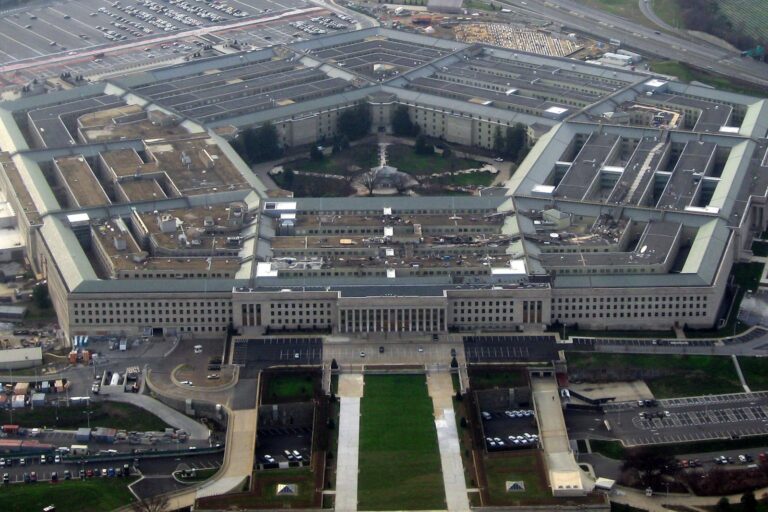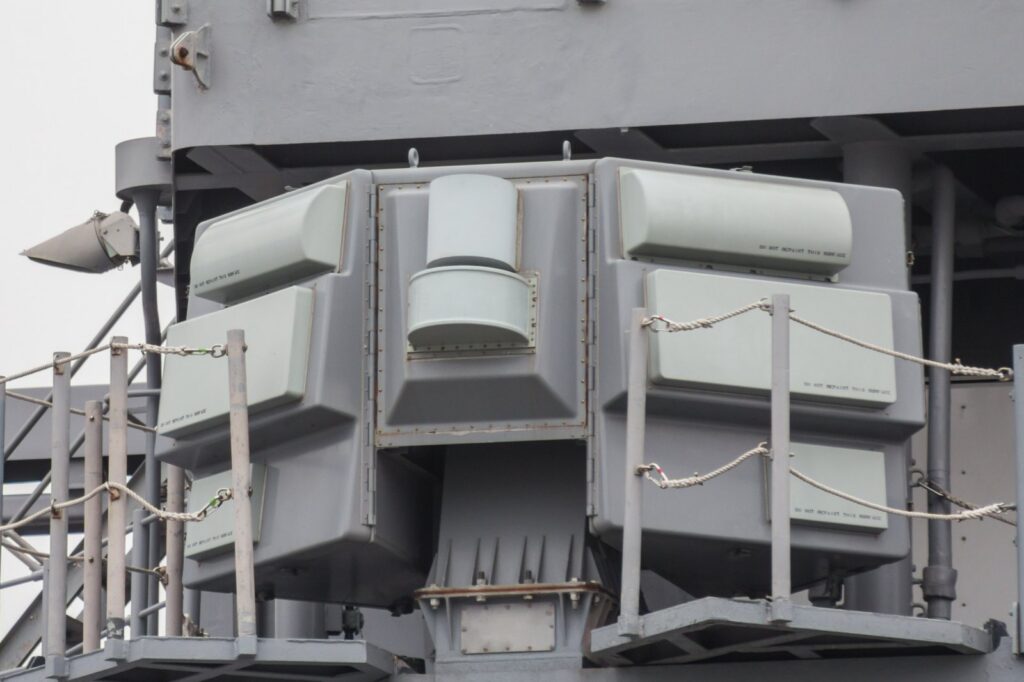
WASHINGTON, November 21, 2026 — The Navy has awarded a $7.125 billion multiple-award IDIQ contract to 28 companies for the Surface Electronic Warfare Improvement Program, the vehicle that funds fleetwide upgrades to the AN/SLQ-32 suite through 2036. The award, announced November 19, spans primes and small businesses competing for task orders covering production, engineering and support across the SEWIP family of systems.
The Contract Vehicle
The indefinite-delivery/indefinite-quantity contract carries a ceiling of $7,125,820,000 and runs through November 2036 if all options are exercised, according to the Pentagon’s daily contract announcements. The Navy received 31 offers via SAM.gov; Program Acquisition Executive Mission Systems in Washington is the contracting activity. Orders may be firm-fixed-price, fixed-price incentive, cost-only, cost-plus-fixed-fee or cost-plus-incentive-fee, giving the service a single vehicle for the full scope of SEWIP work.
The awardee list reads like a directory of the electronic warfare industrial base. Major primes include Lockheed Martin, Northrop Grumman, Raytheon (RTX), BAE Systems, General Dynamics Mission Systems, HII Mission Technologies, Leidos, CACI, Amentum and ManTech. The Pentagon flags 11 of the 28 as small businesses: Frequency Electronics, Ultra Electronics Ocean Systems, CAES Systems, VT Milcom, Aeronix, Distributed Spectrum, Innovative Defense Technologies, PCI Aviation and others. Lockheed Martin builds the Block 2 hardware; Northrop Grumman builds the Block 3 electronic attack system.
From Passive to Active: The Block 3 Leap
The technical reality of SEWIP is a story of incremental block upgrades to a 1970s architecture. The AN/SLQ-32 was originally conceived to augment the AN/WLR-1, entering service in three variants: (V)1 threat warning only, (V)2 adding fire-control radar detection, and (V)3 adding active jamming for large combatants. Carriers received the (V)4, essentially two (V)3 systems tied to a common computer. The (V)5 added a compact jamming module — Sidekick — for Oliver Hazard Perry-class frigates after the Stark incident.
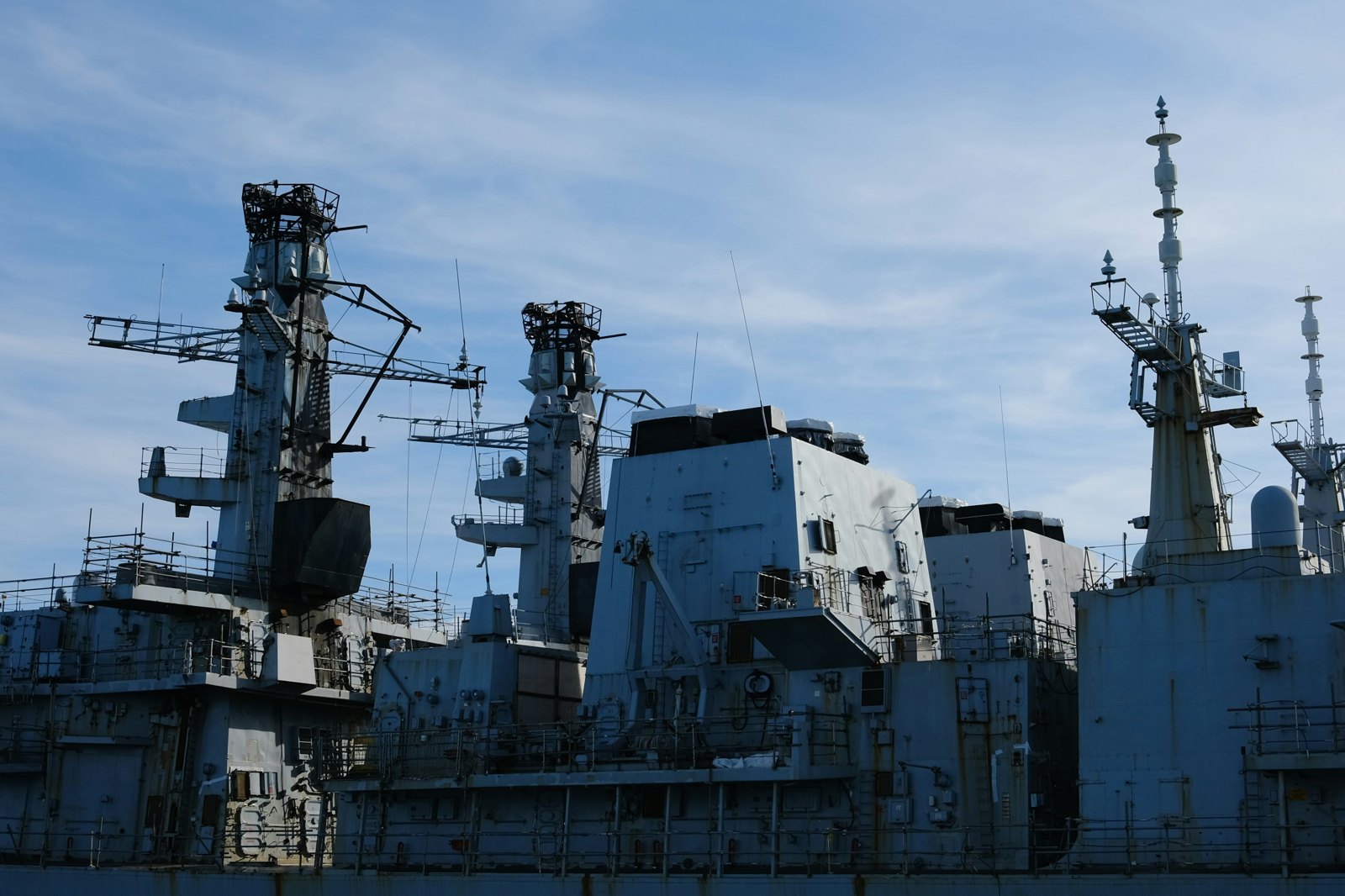
SEWIP itself was established in July 2002 after cancellation of the Advanced Integrated Electronic Warfare System. Block 1 improved displays and added specific emitter identification with high gain, high sensitivity receivers. Block 2 upgraded the electronic support antenna and digital receiver with an open combat-system interface, reaching full-rate production in September 2016. That combination — Block 1B2, 1B3 and Block 2 — constitutes the AN/SLQ-32(V)6, currently in full-rate production for Flight IIA Arleigh Burke destroyers and retrofits.
Block 3 is the detail that matters: it adds electronic attack capability to the (V)6 baseline, designated AN/SLQ-32(V)7. Where previous variants on destroyers and cruisers offered passive detection and threat warning — electronic support, in the lexicon — Block 3 fields active jamming to defeat incoming missile seekers. The distinction is operational: a (V)6-equipped ship knows a missile is coming and can launch decoys; a (V)7-equipped ship can also attack the seeker head-on.
Integration Timeline and Fleetwide Reach
The first (V)7 installation went to USS Pinckney (DDG-91) under the DDG MOD 2.0 destroyer modernization program, with three more destroyers lined up as test ships as of January 2024, according to USNI News reporting cited in the program fact file. The Navy has not published an updated Block 3 production status since. The contract covers upgrades across destroyers, cruisers, carriers, Coast Guard cutters and allied ships — the (V)6 replaces (V)3 and (V)4 variants fleetwide, while (V)7 layers atop (V)6 for the electronic attack mission.
Carrier integration follows a parallel track: the (V)4’s dual-(V)3 architecture gives way to (V)6, with Block 3 electronic attack added where required. The open combat-system interface introduced in Block 2 is the enabler here, allowing the electronic attack payload to plug into the ship’s combat management system without bespoke integration for each hull.
Capability Gaps Closed
The gap is straightforward. Legacy (V)2 and (V)3 suites on destroyers and cruisers provided electronic support — detection, classification, threat warning — and could cue the Mk 36 decoy launching system or the Australian-designed Mk 53 Nulka. They could not jam the seeker of an advanced anti-ship missile inbound. Block 3 closes that gap. The (V)7 adds the electronic attack payload to the (V)6’s enhanced electronic support, giving the ship a layered defense: detect, classify, decoy, and now jam.
As ever, the fleetwide implication is carrier strike group cohesion. A CSG with mixed (V)6 and (V)7 hulls presents a more complex electronic target to an adversary; the electronic attack capability on the screen ships extends the group’s defensive depth. Allied interoperability is baked into the contract language — the SEWIP family supports Navy, Coast Guard and allied ships — and the open architecture means partner navies running compatible combat systems can integrate the same upgrades.
What Comes Next
A planned Block 4 would add electro-optic and infrared sensing capability, per the program fact file last updated in 2021. The contract awarded November 19 provides the vehicle through 2036 to execute Block 3 production and engineering, and to mature Block 4 when the Navy defines requirements. The next scheduled milestone is the continuation of (V)7 installations across the DDG MOD 2.0 line and carrier availabilities, with individual task orders competed among the 28 awardees.
Sources
- AN/SLQ-32 electronic warfare suite
- US Navy Awards 28 Companies $7.1B Contract for Shipboard Electronic Warfare Upgrades
- Navy awards 28 companies a combined $7.1 billion contract for SEWIP shipboard electronic warfare
Photo: Yasu osugi (CC BY-SA 4.0)