Europe is racing to make air defenses cheaper than the targets they engage, a direct response to a cost asymmetry that has upended procurement logic across NATO. The gap between a $50,000 attack drone and a $4 million interceptor missile is no longer a theoretical problem; it is a budgetary crisis documented on the battlefields of Ukraine and the Gulf.
The Asymmetry in the Record
In 2024, Russia’s Geran-3 attack drones carried a unit cost of roughly $50,000, according to Turkish defense industry analysis. At that price, a single $2 million cruise missile could be replaced by up to 40 Geran-3 drones for the same expenditure. The record shows the asymmetry deepened in Ukraine, where Iran-supplied Shahed-136 loitering munitions — costing $20,000 to $50,000 per unit — forced defenders to expend Patriot PAC-3 interceptors valued at $4 million each. Analysts describe this dynamic as a “missile economy collapse,” where the defender spends many multiples of the attacker’s cost to neutralize a single threat.
How the Cost Gap Opened
The economics of legacy air defense were built around engaging high-value targets: manned bombers, cruise missiles, and tactical ballistic missiles. Interceptors like the Patriot PAC-3 or the SM-6 were engineered for kinematic performance against fast, high-altitude threats, requiring advanced seekers, propulsion, and guidance packages that drive unit costs into the millions. The proliferation of low-cost, slow, low-altitude unmanned aerial systems (UAS) inverted that calculus. A defender using a multi-million-dollar missile to destroy a $50,000 drone exchanges strategic depth for tactical survival, depleting magazines that cannot be replenished at the rate of consumption.
The global military unmanned aerial systems market reached $14.9 billion in 2024 and is projected to hit $47.5 billion by 2034, growing at a compound annual rate of roughly 12 percent, according to industry data. This growth is structural, reflecting a fundamental reassessment by defense ministries that the economics of manned platforms — and the air defense architectures built to protect them — are becoming unsustainable. Training an F-35 pilot to operational readiness costs approximately $11 million; the platforms they fly require air defense umbrellas that are now prohibitively expensive to maintain against massed drone attacks.
The Turkish Entry: Korkut and ATOM
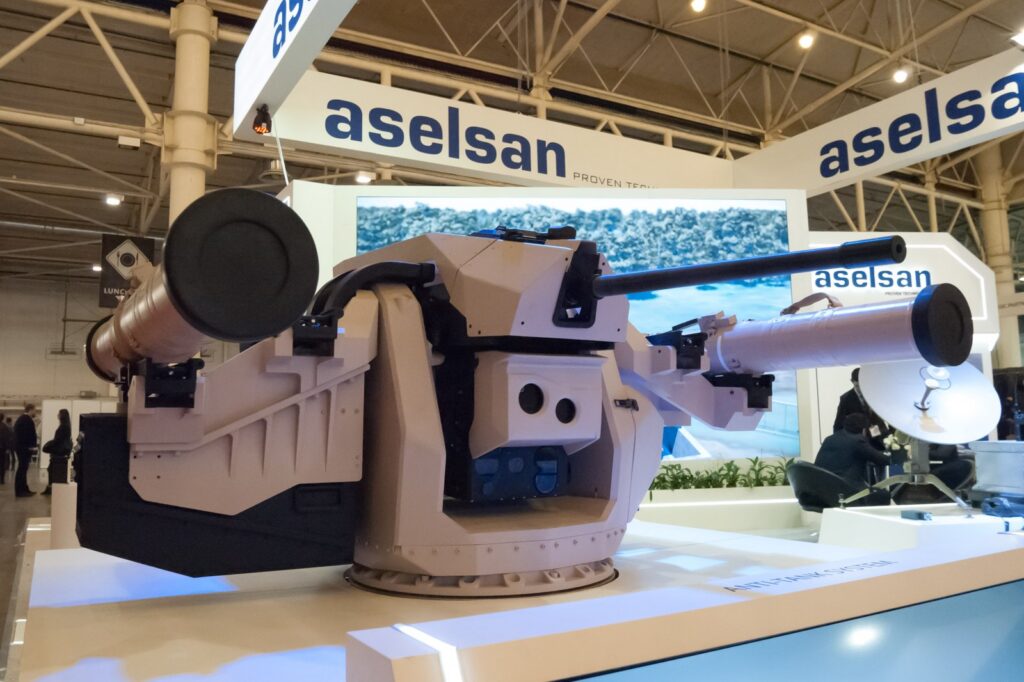
Aselsan’s Korkut air defense system, equipped with 35mm ATOM proximity-fused ammunition, is positioned to capture a share of the multi-billion dollar market created by this asymmetry. The system’s 35mm ATOM round creates a fragmentation effect around the target, allowing small, fast, low-altitude targets to be destroyed in a single shot. The logic is straightforward: eliminate the need to use expensive missiles against individual low-cost threats. The record indicates Aselsan aims to integrate Korkut with an advanced sensor package to counter evolving variants of the Geran series, including the jet-powered Geran-4 and the cruise-missile-class Geran-5, which carry estimated unit costs of $80,000 to $100,000 while offering increased speed and survivability.
Shifting the Magazine Depth
The shift toward gun-based and directed-energy solutions is driven by magazine depth. A vertical launch system cell holds a finite number of interceptors; a gun system’s magazine is limited only by ammunition supply lines, which are orders of magnitude cheaper to sustain. The Korkut approach aligns with a broader NATO trend: investment in AI-enabled radar discrimination, electronic warfare, and directed-energy counter-UAS systems as alternatives to interceptor-per-threat responses. Turkey’s defense industry has targeted a niche between high-priced Western systems and lower-cost alternatives, linking localization and mass production to package deals for drones, missiles, armored vehicles, and naval platforms. This strategy has gained traction in the Gulf, where states scrambled for partners able to supply weapons quickly and at a reasonable price after the rapid consumption of expensive interceptors during Houthi attacks on Gulf infrastructure and the Strait of Hormuz.
The Broader Trajectory
China’s 2018 debut of the CH-7 stealth UCAV and the 2019 appearance of the GJ-11 Sharp Sword signaled a two-track strategy: mass-producible affordable systems alongside high-stealth strategic UCAVs for anti-access operations. The GJ-11 is assessed as capable of penetrating current-generation air defense networks in certain scenarios. Russia has reverse-exported battlefield improvements on Iranian drone designs back to Iran, while Chinese and Russian equipment and North Korean missile technology have been integrated into Iranian systems, according to regional security analysis. This dense military cooperation accelerates the diffusion of low-cost, high-volume threats.
Sources
- Aselsan's Korkut air defense system and ATOM ammunition could create a multi-billion dollar market against drone threats | SSBülten
- The Age of Unmanned Warfare: How Long Will Manned Platforms Survive? – Envanter Medya
- China, Russia, Iran, and North Korea (CRINK) are united on the battlefield as the war continues in I.. – MK
Photo: VoidWanderer (CC BY-SA 4.0)